by Dr. S. Amjad Hussain
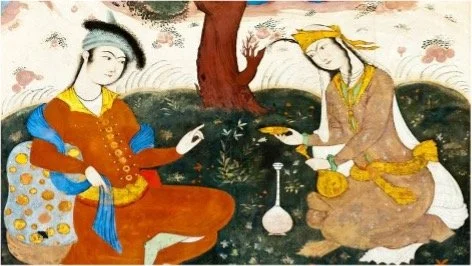
Image source: Chehel Sotoun Palace, Isfahan, Iran / Iranian School (17th c.)
The history of mankind is replete with references to love. We have read about the empires won and the wars lost because of love. We also know that a few years after Emperor Babur’s death in India, his Pashtun wife, Bibi Mubaraka, travelled from Kabul to Agra to bring his remains back to Kabul. She was motivated by the love that Babur had shown towards her—more about her story later.
So, what it is that makes people in love do impossible things? Or, what triggers the process?
In a recent issue, The Economist described love as a power that makes the world go around: a fire that can warm your heart or burn down a house; a deep sea, the greatest pleasure; infinity; blindness.
But still we are unable to explain how it is that two strangers, seeing each other across a room full of people, become nervous, their hearts start racing. Is this something we are endowed with, or just a fleeting phenomenon that has no lasting effect?
Poets, philosophers and sages have talked about love. All they could do was describe the feelings, the longing, but not why they happen. They could see the effects but could not explain the causes. They could say that love is a many-splendored thing, but couldn’t say why.
Helen Fisher, a biologic anthropologist, embarked upon a journey to unravel the secrets of love. She ran an intriguing experiment with 17 students who were freshly in love. They thought of their sweethearts all the time, and she asked them if they would die for that person. The answer was a non-hesitant and affirmative ‘yes’. She put selected students under a functional Magnetic Resonant Scanner (fMRI).
During the scanning, when showing them photos of their sweethearts, a certain part of their brains lit up. This part is in the ventral tegmental area at the base of the brain. It is where the factory that manufactures dopamine is located. It is also where Cupid resides. He has his quiver full of arrows tipped in dopamine and ready to go. Unfortunately, it is also the area that lights up in addicts hooked to food, and with addiction-causing chemicals such as cocaine, heroin, fentanyl, etc.
With the passage of time, one would think the dopamine effect might lose its pull. Two people married a few decades earlier may not show the sex drive of a younger couple, but many are still in love. How does this transition happen? We don’t know. There are couples still in love decades after receiving a dopamine-tipped arrow to their hearts. And they are still in love when sex is not part of their lives.
During his four incursions from Kabul into India, Emperor Babur had to pass through the Yousafzai territory. The warring Yousafzai Pashtuns caused him much grief by attacking his army and impeding his passage. Marriage with a young Yousafzai woman would remove obstacles from his incursion to India. So, Babur asked for the hand of a young maiden, daughter of the chief of the Yousafzai tribe. The tribe agreed, and the girl, Bibi Mubaraka, became one of Babur’s wives.
Babur had always wanted to be buried in Kabul. Indian summers were not suited to his temperament. In just his fourth year of ruling India, at age 47, he died in Agra and was buried there. Following his death, his son Humayun could not maintain control of the vast empire, and lost it to Sher Shah Suri, an Afghan king. Humayun went into exile to regroup. Babur’s family made a hurried retreat to Kabul.
Bibi Mubaraka never forgot that her husband wanted to be buried in his favourite garden in Kabul. Through her emissaries she inquired if Sher Shah Suri would allow her to go to Agra to bring the body of her husband to Kabul. Sher Shah not only permitted her and her retinue to travel to Agra, but he also facilitated the travel. It was her abiding love for her husband that compelled her to undertake the arduous journey of 1,200 km each way to fulfil her husband’s last wish.
In a remarkable long poem about the love between the Yousafzai woman and Emperor Babur, Sahibzada Riaz Noor, a Pakistani poet par excellence, wrote a poem in the voice of Bibi Mubaraka:
I brought him back
From Hind to Kabul
To lay him down
In his resting place final
Thus, did I ultimately
Requite the love he gave
In everlasting
Timeless memory
Now some poets are willing to sacrifice anything and everything for a glimpse of their beloved, or even the black mole on their cheek. Hafez Shirazi was one of those poets:
اگر آں ترک شیرازی بہ دست آرد دل ما را
بہ خال ہندوش بخشم سمرقند و بخارا را
If that Maiden of Shiraz would accept and hold my heart in her hand,
I would give away the cities of Samarkand and Bukhara for the black mole on her face
Turco-Mongol ruler, Amir Timur, had known of Hafez and his poetry. But when he heard the couplet mentioned above, he summoned Hafez to his court. It is said that Hafez, out of fear of the king, presented himself in the court dressed in ordinary clothes. Timur, in anger, demanded to know as to why Hafez was willing to give away the king’s prized cities, that he had conquered by sword, for a mere mole? To that, Hafez replied, “oh my King, I am a careless and unwise man. I have splurged and wasted my wealth to the point that I did not have decent clothes to present myself in your court.” Impressed with Hafez’s presence of mind, Timur forgave him. A two-line expression of love would have brought Hafez’s life to an abrupt and premature end.
Once again, history is replete with examples of wars being fought and lost over love. It has been suggested that Austro-Hungarian empire was defeated in WWI because General Conrad Von Holtzendorff, head of the army, was deeply in love with a married Italian woman to whom he would write daily letters during the war. He was so enamoured with her that he was not paying full attention to the war efforts. The poor devil lost on both fronts.
Every culture has its own epics of love and lament. In English, we have Romeo and Juliet. In Pashtu, we have Adam Khan and Durkhani. And in Punjabi we have the story of Heer and Ranjha. In Sindhi literature we find the tragic story of Sassi and Pannu. Here is one couplet from a 1930 Punjabi ghazal (poem) that was sung by the immortal Kundal Lal Saigal:
پنوں دل دا کھوٹا جے جھانسا نہ دیندا
تے سسی تھلی جا کے سڑدی کدی ناں
If Pannu with untrue heart would not have tricked Sassi,
She would not have died miserably in the desert of Thal
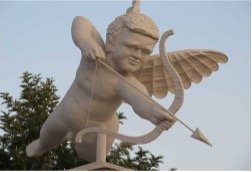
Image source: Wallpaper Flare
Love is a potent force that can move mountains or sweep anything that comes in the way by destroying it. This is not a transient or superficial phenomenon. We are hardwired for love, and the effects of dopamine on our brains are real. Very few mortals can escape Cupid’s arrows.
Love, indeed, is a many splendored thing.

Dr. Sayed Amjad Hussain holds emeritus professorship in cardiothoracic surgery in the College of Medicine and Life Sciences and emeritus professorship in the College of Arts and Letters, University of Toledo. He has been an op-ed columnist for the Toledo Blade and essayist for The Friday Times of Lahore, Pakistan
