by Lena Bercz
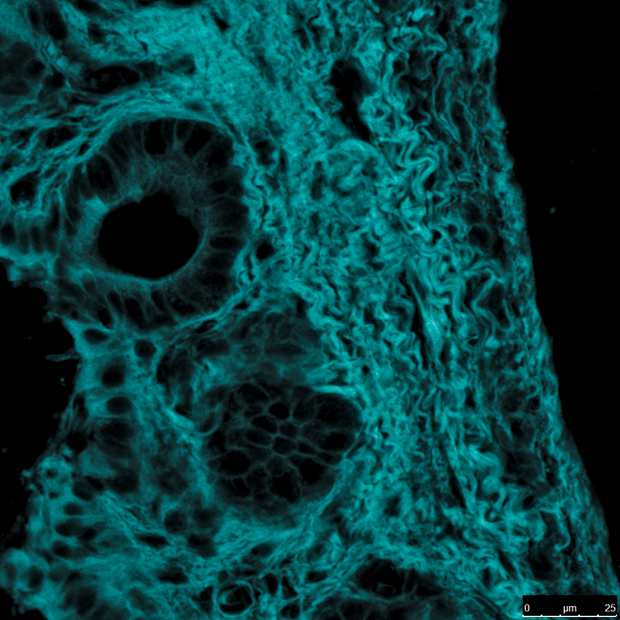
Image displaying the interstitium within a rat extrahepatic bile duct, captured by Dr. Rebecca Wells using second-harmonic generation microscopy. In blue, collagen bundles making up the support structure can be visualized, and the black gaps represent spaces containing cells, carbohydrate residues, and free-flowing fluid.
Humans are wired to seek answers. It’s in our nature to explain and systematize the world around us, shaping our understanding into neat frameworks we call “facts”. This instinct is deeply comforting and provides us with a sense of control in an unpredictable world. This is an incredible strength of ours, setting us apart from other species. In science, this way of thinking has led to unbelievable discoveries, from mapping the cosmos to decoding the human genome. However, can this drive be a double-edged sword, blinding us from possibilities that don’t fit within our established way of thinking?
Medicine, as any scientific discipline, is built on a foundation of evidence and logic. However, as it is shaped by human minds, it is not exempt from the blind spots and biases that we inherently carry with us. This brings us to one of the most fascinating medical discoveries of recent years: The Interstitium, a newly classified human organ system that was hiding in plain sight.
In 2018, a team of pathologists at New York University led by Dr. Neil Theise, was studying a bile duct when they discovered a peculiar honeycomb-like network of small holes lining the organ. After further investigation, it was found that this structure is not limited to the bile duct – it lines almost all organs and spaces in the body and is present throughout connective tissue, containing fluid rich in nutrients and proteins. This vast network functions as a “highway system”, allowing for the flow of fluid across the body, interconnecting all organ systems and spaces. Despite interstitial space being a known structure in the medical world, it has been previously misunderstood as dense, solid connective tissue merely making up the “space” between organs, rather than a dynamic fluid-filled network (1).
This entity has been found to be immensely significant, containing over 25% of the body’s fluid – over four times the amount of fluid found within the cardiovascular system. Fittingly speaking to its role as an in-between space, this “new organ system” was named The Interstitium. Further research has shown that the interstitium plays a prominent role in molecule transport and shock absorption. It was also found to be a crucial piece of the puzzle in processes we haven’t well understood including chronic pain, cancer metastasis, and the way our bodies store trauma (2). Despite its exciting implications in medicine, one of the most interesting aspects about the interstitium is that it was discovered so late. It remained unrecognized for so long, not because we lacked the technology or knowledge to uncover it, but because our beliefs stood in the way of our perception of it.
For centuries, microscopy specimens have been processed by being sliced thin and dried out using special techniques. In doing so, interstitial spaces collapse and appear in the form of cracks under the microscope. Previously, when cracks were observed, they were written off as trivial products of the sample preparation process, instead of ever prompting a second thought or being questioned as a potential clue into an unseen system. Notably, the interstitium is so large that it can be appreciated with the naked eye during dissection, yet it went unquestioned as it did not fit within the framework that we had long accepted for how anatomy should look (1).
The story of the interstitium teaches us an uncomfortable yet imperative lesson: Our deeply held beliefs can blind us from truths that might be right in front of us. The categorizations that we use to make sense of our world may limit our perceptions of it, even in fields as disciplined as science.
Beyond this, the interstitium demonstrates how rigid thinking hinders progress and urges us to consider the coexistence of multiple truths. One of the most fascinating aspects of the interstitium is that it hints at a bridge between different philosophies of medicine that have long dismissed each other. Western medicine, built on a foundation of evidence-based practice grounded in principles of biochemistry, physiology and anatomy, has long rejected traditional Eastern practices, such as acupuncture, due to their mechanisms not aligning with Western models. In contrast, Eastern medicine has traditionally emphasized the movement of energy throughout the body – known as chi – offering a more holistic and intuitive approach.
Although further research is warranted, it has been suggested in the literature that the newly described interstitium, allowing for the flow of energy and fluid throughout the body, likely plays a role in traditional Eastern medicine practices, grounded in the concept of chi, that have been around for centuries (3). This reminds us of an essential truth – phenomena dismissed as unexplainable may simply reflect gaps in our current understanding. Just as light is both a particle and a wave, different ways of thinking can highlight different aspects of medicine and may coexist. Perhaps both approaches offer a piece of a larger puzzle and dismissing one because it does not neatly fit into the other’s framework is a mistake born of arrogance.
As a third-year medical student navigating clinical rotations, learning the craft of diagnosis and treatment plans through scientific reasoning, the story of the interstitium captivated me in a grounding yet unsettling way. It serves as a humbling reminder that the human body, let alone the world around us, is far more complex than we currently understand and most certainly ever will. It reinforces the importance of embracing the unknown and being willing to question even the most fundamental understandings. The interstitium urges us to remain open to different perspectives, even if they seem to challenge our own, and accept that our understandings are rarely the final word, rather, pieces of a larger understanding.
Questioning ideas is not a threat to science; it is the very essence of it. The path forward lies in curiosity, humility, and willingness to recognize that there is always more to learn.
Sources:
Rettner, R., & LiveScience. (2018, March 27). Meet your interstitium, a newfound “organ.” Scientific American.
Benias, P.C., Wells, R.G., Sackey-Aboagye, B. et al. Structure and Distribution of an Unrecognized Interstitium in Human Tissues. Sci Rep8, 4947 (2018). https://doi.org/10.1038/s41598-018-23062-6
Tomov N, Atanasova D, Dimitrov N. Is the Newly Described Interstitial Network the Anatomical Basis of Acupuncture Meridians? A Commentary. Anat Rec (Hoboken). 2020 Aug;303(8):2169-2170. doi: 10.1002/ar.24114. Epub 2019 Apr 9. PMID: 30874366.
The space between. (2018, October 10). IEEE Pulse.
Lena Bercz is a fourth-year medical student at UTCOMLS.
