Borken Economy
by Solee Cheon
Shocked is not it.
A massive ripping away
and we
pretend
to be appalled by the infected tissue
and atrophied muscle mass.
Yellow pus has always been seeping out
staining white medical gauze
a gross disparity laid clear
in two lines
halves halve nots
My body lays with the poor and undocumented.
My hands cover the diseased and untested.
My eyes watch as the underserved get passed
over and strewn out like pieces of toast
on Central Park ground.
Solee Cheon is a third-year medical student at the UTCOMLS.
The Great Dissector
by Nathan Hershberger
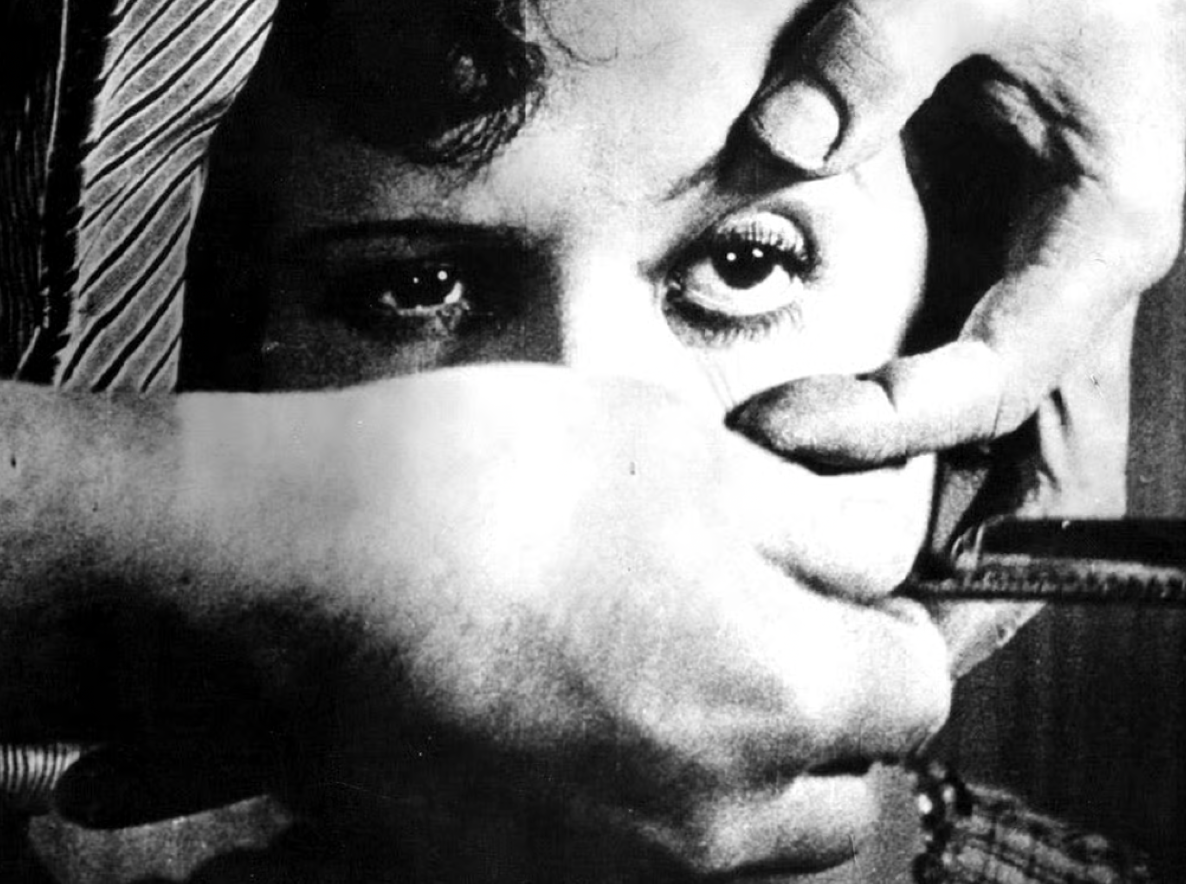
Image Source: Un Chein Andalou / Luis Buñel
Come one, come all! Don't miss the show tonight!
Come see The Great Dissector live at nine!
Come marvel as he deftly shines his light!
Come have exposed your pulp beneath the rind!
Come in! The stage is set and crowd advised,
"Sit back, relax, distract not this display."
So give your name, and thus you're etherized.
Incision starts, "what brought you in today?"
Be still! His hand is firm, his voice will ease,
As layer by layer his probe moves deeper in
To find the germ and excise your disease.
His act is called: The Art of Medicine.
So come! The crowd awaits another case,
And fear not, my friend, we'll soon forget your face.
Nathan Hershberger is a second-year medical student at UTCOMLS.
Peace Amidst Chaos
by Mary Grace Hamlin
Artist’s Statement:
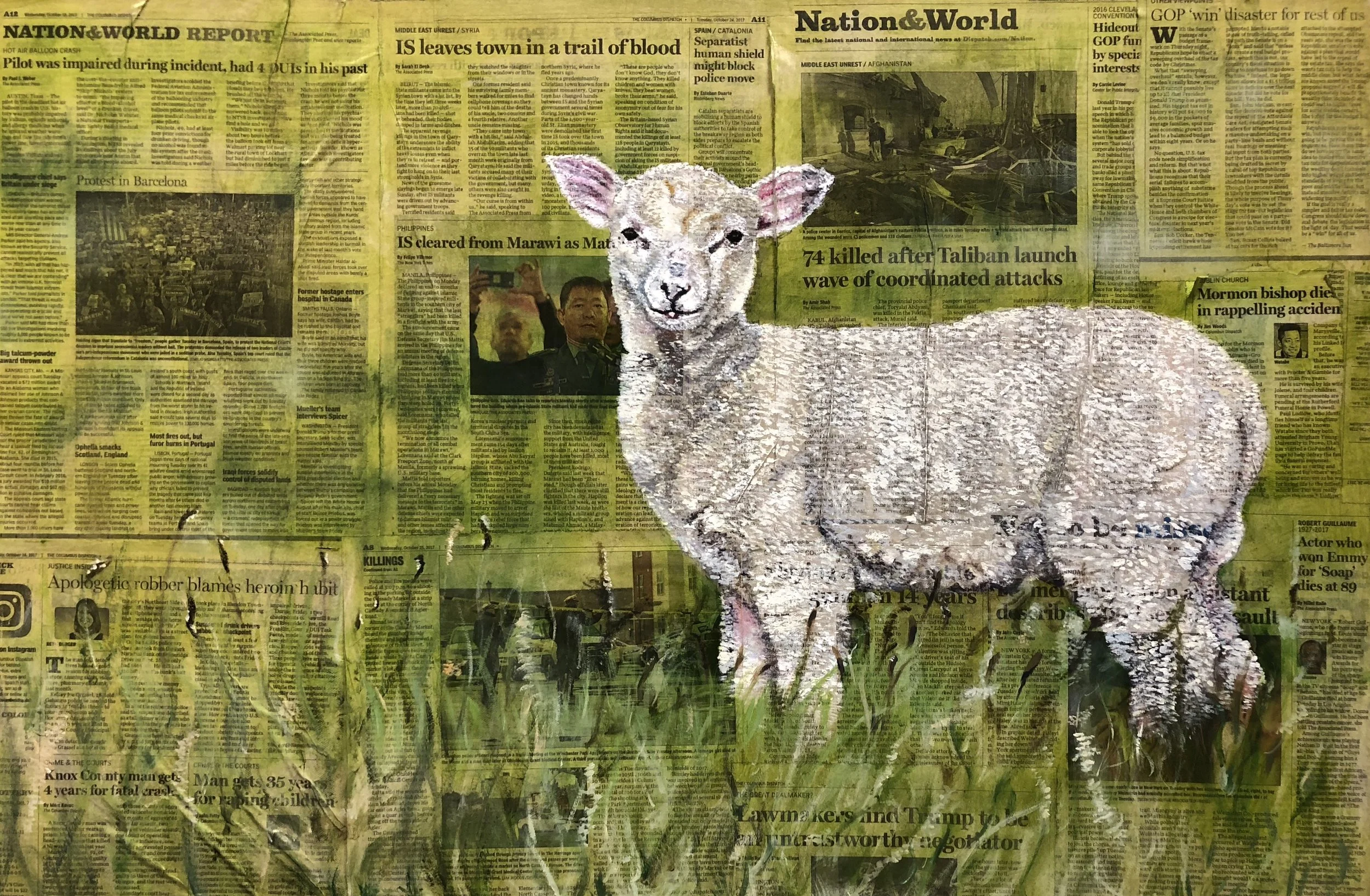
Peace Amidst Chaos illustrates the precious moments that we as medical students find to center ourselves among our many competing priorities and responsibilities. Its backdrop is comprised of newspaper articles detailing negative news and tragedies of everyday life. At the center, the lamb stands calmly. She embodies our shared quest to ground ourselves amidst the relentless noise we face as we study and train to serve our communities. This piece is an invitation: The viewer is welcome to pause, breathe, and reclaim a moment of peace whether you are in the middle of a busy clinic, difficult day of studying, or carrying the unseen weight of caring for others.
Mary Grace Hamlin is a third-year medical student at the UTCOMLS.
Dean of the Beozars

Image source: Unsplash
by Thom Hawkins
The king’s cook, François Villard, did not steal the silver to feed his family. He had no family. He did not take it to feed himself—though not rich, his job left him with enough. He lived in the servants’ quarters which met his minimum physical needs for food, shelter, and clothing.
That he was caught was not a surprise. It was not the first time a servant had stolen, and thieves were invariably caught. When something was missed, and it always was, the servants’ quarters were checked, and because the rooms, despite their name, did not belong to the servants, there was no place for objection. Villard had not even hidden the plates especially well, as if he expected to be caught.
The punishment then, for this crime that he did not need to commit and for which he knew he would be caught, was death by hanging.
Death from hanging carried the same kind of certainty as being found a thief did for taking the silver. One event always led to the next. Villard had hung himself. He showed no emotion during his room search and did not feign surprise when they found the silver. He did not cry when shackled and taken to a locked cell or while waiting for his hanging.
* * *
King Charles IX of France studied the object in his hand—a stone, no larger than the tip of his finger.
“It is an antidote to all poisons,” Señor Vargas explained, directing his words at the base of the young king’s throne.
Though it could have fit on a ring, its black, bulbous appearance made such a mounting undesirable.
“Where was it found?”
Señor Vargas kept his eyes downcast as the king held the stone between his fingertips, and brought it up to his nose.
“It was, your excellency,” Vargas said, then hesitated, his flushed cheeks matching the sleeves of his satin doublet, “found inside the stomach of a goat.”
Charles signaled and a courtier appeared by his side, hand outstretched. The king placed the stone into the courtier’s palm.
“How does it work?”
“Ah,” Señor Vargas said, “I only know that it does.”
“How do you know this? Have you tried it?”
“No, Your Excellency, but I know of others who have.”
“The same stone?”
“No, stones found the same way.”
“Is it worn or eaten?”
“It is, your excellency, crushed into a powder and made into an elixir.”
King Charles glanced at the stone, still in the courtier’s open hand.
“Bring forth Monsieur Paré.”
* * *
Villard looked up at the sound of a key in his cell door and watched as the door opened to reveal a man dressed too well to be a guard, with a grey beard pressing down on the front of his ruff. The man entered and stood in the center of the cell, commanding it, but Villard did not shrink back, nor did he speak. Villard waited for the man to speak, but he seemed in no hurry to communicate his purpose; instead, the man stared at him, as if assessing odds for his escape. Finally, he said, “You stole the silver.”
“Yes,” Villard said, without hesitation.
“Do you know the punishment?”
“Hanging.”
“Death by hanging,” the man clarified.
“Who are you?”
“My name is Ambroise Paré. I am his majesty’s surgeon.”
* * *
Ambroise Paré lived amongst the court at Clermont. As a practiced battlefield surgeon, a specialist at treating war wounds before he came into the service of Henry II, continued under Francis II, and now Charles IX, he became a trusted advisor to the king on matters medical and scientific.
Summoned, Paré appeared at the king’s side.
“Ah, Paré. I have a matter for your expertise.”
“Yes, your excellency?”
“Is it possible that a substance could act as an antidote to all poisons?”
“No, your excellency. There are many sorts of poisons and venoms; one might oppose some of them but not all of them.”
Señor Vargas glared at this aging obstructer, with his short-cropped hair and pointed grey beard. Paré, not knowing the gentleman, kept a cautious eye on Vargas as he continued to elaborate for the king.
“Poisons do not all kill by the same method. Some operate by an excess of elementary qualities of which they are composed; others operate by their own specific qualities, occult and secret. Hot venoms must be cured with a cold remedy and cold venoms with a hot remedy.”
“What about alicorn?” the king asked Paré, nodding at Vargas. Knowing Paré’s thoughts on this matter, he asked for the benefit of their visitor.
Paré turned and addressed Vargas directly—“That substance which some call alicorn, supposedly the horn of the unicorn, is almost certainly not. The beast itself is unlikely to exist, at least as described, and the quantities of alicorn available for purchase from an animal seldom seen is improbable. I have witnessed physicians giving ground bones of horses or dogs to ailing men with the same effect as alleged alicorn, provided they were told it was such.”
Vargas watched King Charles listen as Paré spoke and shifted his stance as the king nodded in agreement to Paré’s logic.
“Another alleged cure is the preserved bodies of ancient Egyptians. These mummies are also available in greater proportion than they should be, given the number of burial sites that have been uncovered in Egypt. I have heard tell of a great trade within our own France of the resinous preservation of recently dead slaves. But despite this source being well-documented, there are many who will pay to eat their flesh in the hope of a cure. I must conclude there is no single antidote against all poisons.”
King Charles turned his attention back to Vargas, who took a moment to recover his argument.
“Your excellency, I brought you this stone as a gesture of friendship, a protection against our common enemies. Monsieur Paré is obviously a great mind and a trusted advisor, as well as familiar with the remedies and magics of France, but this stone is from Spain, and we have been using this remedy for centuries.”
The king nodded at the courtier by his side, who held out the stone for Paré’s examination.
“A bezoartick stone. I have heard of such a thing.”
Vargas smiled.
“But it cannot be a universal antidote.”
Vargas frowned. “But this one’s from Spain…”
“We could conduct a test,” Paré offered.
King Charles smiled. “Continue.”
“Your excellency, you no doubt have some rogue in your prisons condemned to be hanged. We could, instead, serve him a poison, followed by application of the bezoar stone. This will prove its worth.”
* * *
Villard had heard of this man, but had never seen him. Paré’s piercing eyes and serious manner fit his expectation of a man who had saved many lives. Yet why Paré—someone with a reputation for preserving life for those doomed by chance to die, sat in the cell of a man declared to die remained a mystery.
Paré spoke: “Are you familiar with the properties of the bezoar stone?”
“It cures poisoning.”
“How?”
Villard shifted in his seat. “You’re the scientist.”
“I would say there’s no scientific basis for the alleged powers of the bezoar.”
Paré watched Villard’s brow wrinkle, then straighten as he combined the two lines of inquiry, the hanging and the stone. Villard nodded, signaling he knew what Paré would propose.
“I’d like to try an experiment. It’s a wager, really. You believe a bezoar stone will cure poisoning. I do not. A fatal dose of poison will be administered to you, followed by a solution of the bezoar stone. If you are cured, you go free. If you are not…”
“I will die.”
“Precisely.”
“The certain death of hanging against the possibility of death by poisoning. And if I survive, I will go free?”
“Yes.”
“But I committed a crime.”
“You will not be executed.”
“I will no longer be a servant.”
“No, you cannot be trusted. But you will be free.”
“Free to do what?”
“Free to leave.”
“One option? That isn’t freedom. Freedom is choice. I’ve never had a choice. Everything I’ve ever done I had to do.”
“I have given you a choice.”
“What choice have you given me? If you do not believe the stone will work, for you, death is certain either way. There is no difference. There’s only a choice if I believe the stone will work.”
“To have faith…”
“Yes, I must have faith that the stone will cure me. Only then do I have a choice, and that’s a choice I have to give myself. Without that, there are no options. You’ve already chosen death.”
“Have faith in God.”
“God will save me? What will that do to your experiment? Is it God who will save me, or the bezoar?”
Paré ignored Villard’s questions, regretting that he raised the question of faith. “The outcome is the same, but the method… poison… is not a quick end.”
“It is you who will poison me?”
Paré hesitated, surprised by Villard’s direct accusation. “No… I will not prepare or administer the poison, only the antidote. This way I can preserve the integrity of the experiment, to ensure I do not prepare an antidote using the bezoar stone that is specific to the poison provided…”
In a sense, the very notion that the bezoar could be his equal offended him. A simple bezoar stone did not have his learning or experience. If man could be cured with such a simple remedy, what use was there for him? He was a man of science, of knowledge, a righteous man who used his skills to save other men. No, he would not administer the poison. That was a job for some vicious brute. It didn’t take talent to kill a man, only to save one.
Villard, though common, jarred Paré back to the present matter with his logic. “If you do not believe that the bezoar stone will save me, then you are administering my death. You are the executioner, whether or not I die.”
Paré did not respond to the accusation with words, but his tone made it clear that Villard had gotten to him. “What is your choice?” Paré grimaced at his own selection of words.
“My choice is that I would rather die in prison than on a public stage.”
“Very well.” Paré turned away from Villard, avoiding a look into the eyes of a dead man, a man he now feared he would kill by his own hand.
* * *
Paré did not witness the preparation of the poison. M. de la Trousse, the house provost, oversaw this part of the operation. He did not identify himself or his relation to the king when he visited M. Lavande, the apothecary on the Rue des Bourdonnais. He asked the apothecary for a strong poison, and left it at that. Despite the unusual request, Lavande asked no questions, knowing the well-dressed gentleman could pay. Lavande did not keep such a poison in his shop, but knew well how to make it. He asked M. de la Trousse to return after two bells.
In his back room, Lavande measured out mercury and sulfuric acid into a conical flask. Bubbles rose from a reaction, forming mercury sulfate. Adding sodium bicarbonate, Lavande filtered off the brown precipitate, then dripped in hydrochloric acid and evaporated off the liquid until only tiny white crystals remained. He ground these into a vial and presented it to M. de la Trousse when he returned.
“Put this in any liquid and drink it,” Lavande told him as if he was planning to poison himself. “If you had the strength of twenty men, it would still achieve its effect.”
Paré’s preparation of the bezoar stone required fewer steps, though he took just as long. At his desk, he held the stone in his hand as he reflected on the conversation with Villard. He thought back to a horror he had witnessed years before, as if to absolve his own guilt with that of another. Years earlier, during the Battle of Milan, an officer asked if Paré could save a soldier with severe gunpowder burns. Paré admitted that he could not. Without hesitation, the officer unsheathed his knife and slit the soldier’s throat. As the blood gushed from his jugular, the soldier’s head fell to the side, hitting the earth beneath.
Paré picked up the bezoar stone preciously, still thinking of the soldier’s head, its eyes still open, but with no life behind them. The stone had three lobes of silvery black with veins of mahogany between the lobes. It looked like a river wore it down, or a stream of merchant’s hands as it made its way from a goat’s stomach into the possession of Señor Vargas. This insignificant thing was treated so preciously because of its alleged powers.
Paré took great care preparing the bezoartick solution, as if this attention could be the difference between life and death for Villard. At the same time, he harbored resentment that he could be replaced by a rock. Placing the calcification in his mortar, he pressed straight down on it with the pestle, imagining a rope pressing on Villard’s windpipe. Was it possible for a man to survive a hanging? All men died eventually when left to hang. All men died eventually. Their windpipe crushed, jugular collapsed, wheezing, faint, and dead.
Villard had caught him in an intellectual noose. Paré wouldn’t die today, but he began to feel the pressure at his neck and sensed the eventuality of judgment. One event always led to the next.
The bezoar stone collapsed under the combined weight of the mortar and Paré’s conscience. It was no longer an artifact. It couldn’t be held in one’s pocket or mounted on a ring. It could only be used now in an attempt to save the life of Villard.
Paré ground the pieces into as fine a powder as he could manage to increase the dissolution. The black stone transformed to a light brown powder. It could easily be mistaken for, or replaced with, dirt from the courtyard. The idea now that this could save a life seemed preposterous. Was he to save Villard with this? Paré, a man of medicine, with all his experience and knowledge, was now to face a dying man and present him with this ineffectual remedy. The words of Hippocrates sounded in his mind: “I will use treatment to help the sick according to my ability and judgment.”
Paré mixed the powder into a flask of water and set out for Villard’s cell.
When he arrived, M. de la Trousse stood waiting. M. de la Trousse wore a hip-length cape that ended just above the hilt of his rapier. The sword gave him a look of authority, although, as provost, it remained sheathed. The blade could mean a quick death, but instead he held a goblet of wine into which he had already stirred Lavande’s white crystals.
Paré tried to seem disinterested, but even as he turned away, he held an image of the goblet in his mind. It was that goblet against his flask. That was the choice now. Death or…
He did not enter the room with M. de la Trousse. He did not hear the struggle he had expected. Villard must have accepted his fate. He made his choice.
When M. de la Trousse exited Villard’s cell with the empty goblet, he nodded at Paré. Paré entered and saw Villard already struggling, sweaty and red. He rushed to Villard, grasped the back of his head to tilt it back, and poured the murky solution between his lips. Villard didn’t speak, but his eyes sought contact. Paré glanced at him. He could see in that brief moment that Villard knew the bezoar would not save him.
Avoiding Villard’s gaze as he emptied the flask, Paré noted Villard’s thin neck braced in his fingers. Villard would not have hung for long. He wanted to say something—to offer comfort in his choice, or to apologize for the part he played in this scene, but Villard, after swallowing the bezoartick solution, opened his mouth to speak first. Paré leaned in, turning his gaze from the face of his patient. But instead of words, Villard screamed.
Paré fled the room at the apparition, and returned to his chambers haunted by the scream it seemed he could still hear.
A knock startled Paré. A guard from the prison appeared at the doorway to escort him to Villard’s cell. As he followed behind him, Paré noticed a knife sheathed at the guard’s leg and imagined it dripping with blood, leaving a trail like bread crumbs.
Villard was in limbo. The King’s surgeon would open the cell door and either free Villard, or declare him dead. The sound of Villard retching had replaced the screams. Inside the cell, he looked far worse, crawling around on all fours sweating and heaving, with blood issuing from every orifice. It was clear that the bezoar stone did not save Villard. The experiment over, Paré realized that Villard could still go free if he could save him. The stone had lost, but he could still win.
He barked at the guard to bring him oil and water. The extreme symptoms seemed far worse than those from an arsenical poison. Still, he could likely find some relief with the water, and if he could keep the oil down, it might still work to protect him.
Villard drank the water, sputtered, and vomited. Time had run out to stop the poison. No longer the stone versus Paré, the poison had bested them both. Taking some oil into his palm, he pressed his hand against Villard’s brow.
“May the Lord pardon thee.”
With Villard’s shivering head laying in his lap, Paré looked down and could only see the head of the soldier, throat sliced open, dead eyes lolling back at him.
He stood up, lowered the head to the floor and backed away. The cell door, having served its purpose, lay open, and Paré once again fled through it, pushing past Vargas, his own screams echoing after him.
Minutes later, with his death, Villard was free.
Thom Hawkins is a writer and artist based in Maryland. His stories, plays, and experimental fiction have appeared or are scheduled to appear in Always Crashing (Pushcart Prize nominee), Bloomin' Onion, Encephalon Journal, Excuse Me Magazine, Gargoyle Online, New Myths, Oyez Review, The Scop, Shoegaze Literary, Slippery Elm, Variant Lit, and Verdant Literary Journal.
After Pieter Claesz
by Vivien Holop
Artist’s Statement:
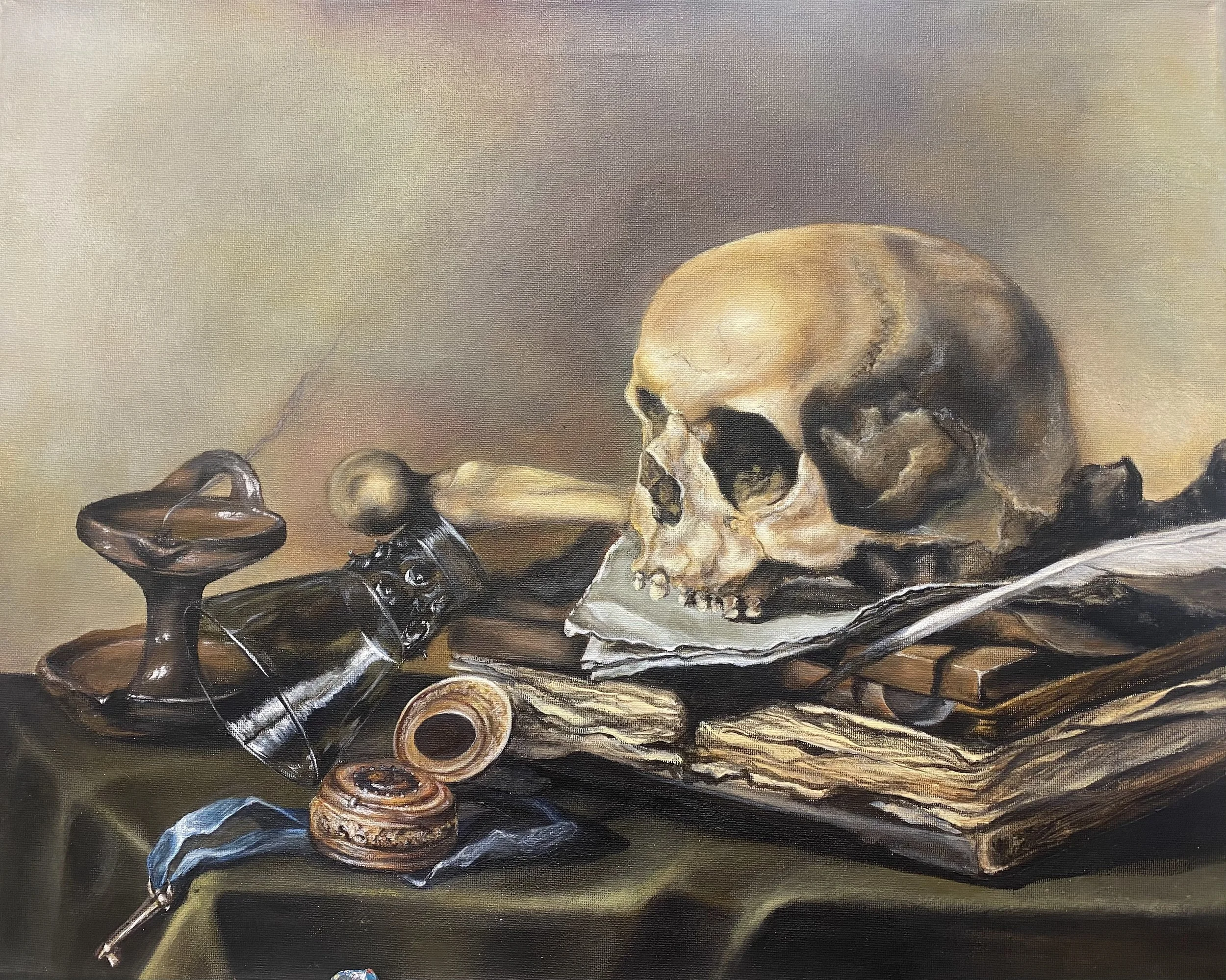
This painting is a replica of the work of Pieter Claesz, a Dutch painter known for vanitas still lifes that reflect on mortality and the passage of time. The composition features symbolic objects, including a skull, books, and other instruments, to convey the fleeting nature of knowledge and time.
Media: Acrylic Paint
Vivien Holop is a second-year medical student at UTCOMLS.
Turning 85
by Dr. Lloyd Jacobs
The corporeal world is my world, comprised
of the detritus of my mind
the ash and CO2 which flow from my thought
to become mountains, the moon and the sky
I sustain the universe by my memory and
imaginings; I bring on the night by my dreams
and light the day by my intentions.
Molecules and bosons are here at my invitation
and dance to my patterns and my syncopation
I extend my hospitality to Satan and am
complicit with him in creating truth and beauty
I hold God in existence by my animus and will.
And yet, I am diminished by each day
to die moment by moment, incessantly. Things
of substance no longer hear my music, are no
longer seen through the apercu of my vantage.
Death stalks me. My hair is sparse, my eyes dull
my limbs are bowed, my phallus abject; my mind
augurs death and dwells on annihilation.
Who will perform my offices when I’m gone?

Dr. Lloyd Jacobs is President Emeritus of The University of Toledo. He has published 3 collections of poetry and was previously a professor of vascular surgery at the University of Michigan
Between the Rooms

Image source: Unsplash
by Shreyas Banerjee
Artist’s Statement:
This piece is a work of creative nonfiction drawn from experiences during my third-year clinical rotations in medical school. Rather than following a single patient encounter or chronological narrative, it unfolds as a series of interconnected vignettes linked by recurring moments of music, memory, and transition. Its form is informed by the stream-of-consciousness techniques of the early twentieth-century modernist writers I love such as James Joyce, Alfred Döblin, and Virginia Woolf, adapted here to reflect the fragmented rhythms of clinical education and the fleeting encounters that shape it.
Toddling down the vacant hallways, monitor screens reflecting off the quiet floors, an empty dread fills my stomach. The first week of rotations and already running late, the time ticking away on my watch. Badge in, walk through the automatic doors into the Pediatric ICU. They unlock for you; are you worthy of that? The 6 a.m. sky glows, morning blue diffuses through the intermittently open patient doors, little worlds dying behind the closed ones.
The night shift resident and the other medical student gossip and laugh together as I scramble to set my belongings down in the back room. Morning, I mutter. Chart dig like the good med student you wish to be. Was it a fish bone diagram you’re supposed to use for electrolytes or was that vitals? Patient status unchanged, no acute events overnight. Then why do I see three order changes? A six-month-old, born premature and on and off a ventilator since birth. Underdeveloped alveoli, arrested exchange. What sort of life does she know? My confusion over the mechanics of bronchopulmonary dysplasia is trifling. Softly sighing, I step out before stopping, retracing my steps, and grabbing my forgotten white coat. Already crinkled of course, can’t be helped. Check its pockets: stethoscope, pen, notebook, miniature eye chart. Probably don’t need that last one for pre-rounding in the PICU. When I was given that chart by my professor I was always told to “keep your eye on the patient.” A pun on their part. I suppose that’s my job right now.
A soft knock on the door and a tentative step in, orange flickers creep into the lapis horizon. In the moments between, before I look over at the bed, I hear a whispered croon.
“Blossom of snow, may you bloom and grow
Bloom and grow forever”
She stops and looks at me, sheep-faced, glasses drooping as she stands over the crib. The undulating hiss of the ventilator fills the room, inhaling and exhaling. For a moment she was transported, carried away on waves of sound and memory. Now she is back in a place where she must answer questions for a student who doesn’t know what to ask.
Scrolling weeks swiftly pass in the life of a student. Rotating through, ever-transient, rootless, adrift. Learn the routine of a place, move along. Many people I meet along the way but most of the time I’m just confronting myself, my knowledge, my plasticity. In the long hours of the evening, I return home. The computer screen stays ever bright as all other lights recede, practice questions blinking in the retina. Don’t complain about something you signed up to do,; just get it done. Sitting in bed, blanket over legs, I find this life isn’t so bad. Switch to YouTube, try to find something to stir your studying. Let the homepage algorithm think for you, lazy bee. Looking at a collage of videos and songs of times long past, I wince. No wonder your listening age on Spotify is 93. Every comment section is filled with remembrances, exclamations of being transported back into the homes and arms of their loved ones for just a moment, caressed by invisible vibrations. As I listen, I share worlds with those shades that have passed and those on their way. Helen Forrest inhabits mine as her voice rings around my room.
“Through the mist of a memory, you wander back to me
Breathing my name with a sigh”
Click to submit answer. Dyshidrotic eczema (acute palmoplantar eczema) is characterized by a recurrent, pruritic, vesicular rash that primarily affects the palms, soles, and sides of the digits. The diagnosis is based on clinical features, and treatment includes high and super high-potency topical corticosteroids. I see.
Knocking and introducing, ever-forking paths always seem to take me to the same place. Stomach pain? Yes. After you eat? Yes. Impedes your life? Yes. Palpate. Ow. Let’s take the sucker out. Risks and benefits roll off the dome, images of mass transfusions fill my mind but aren’t shared. How many gallbladders does it take to reach the end of a surgery clinic’s day? The world may never know. After rotating through many outpatient sites, the ones with good flow become apparent. Here we have pre-written histories taped to the door. Well-trained medical assistants make all the difference. Take mental notes for the future. Survive a pimp, dodge a lance, the steps to this cha-cha become smoother over time. Whether it’s hot or cold, the weather is always an easy start of conversation with people you’ve never met and will likely never meet again. Today the solipsistic sun crowds out the cloudless sky, beating down on us all. What else is new.
Looking down on my notebook to remember the patient’s name, I enter. Familiar words pierce my consciousness from the grilles of a phone.
“And I discovered that my castles stand
Upon pillars of salt and pillars of sand”
The sounds of stadium rock bounce slightly up and down with the rhythmic contractions of his right gastrocnemius. Really? Coldplay of all things? We all have weary tunes we lay down on to steady the nerves I suppose. In the split second between my looking at him and his looking at me, he’s gone far, far away, the king of a forgotten castle, tapping away. Who am I to judge the ways we cut our tethers to this realm? He looks up, the pause button pressed, the phone shakily stowed. Time for my routine and his reality. Now how about this heat wave?
Freezing, squirming in my scrubs, I spin my gown. I’ve passed into the city of woe. This is an aseptic place, all considerations of life driven away for the one we’re trying to save. No light enters this domain of steel and blue. Time does not exist; the clock is frozen. Emanations of bilious aura fill the room. You want to scratch your face, don’t you with that nose of yours writhing under that mask? Fingers flexing, back aching, leaning against the open human body. Getting by with a little help from my friend. At least I’m not the one being operated on. Too long or too short: the eternal dilemma. I’ve abandoned hope of figuring it out long ago. Just cut. Finally, the nurse has chosen a song.
“Are you reelin' in the years?
Stowin' away the time”
My soul soars high out of my chest. It transmogrifies into a bird, flapping away in the clear guitar sizzle over rivers of running piano. It glides radiant, sublime, above the suffering of all others, away from the crying exudations of this world. It flies in concordance with prisms of perfect harmony, refracting a gleaming light around all else. It communes with every soul who ever has and ever will find solace through the song.
The case ends. I scrub out.
Logging in over and over on clinic computers, my passphrase has become imprinted on my hippocampus. “Who cares for you?” What started as a remembrance to Lewis Carroll—I would think of the rest of the quote “You're nothing but a pack of cards!” while typing—has now become bored into my being as just the solitary question. Perhaps not the best thing to have ringing in your head repeatedly through the bitter winter months. Longitudinal care.; I’m just a flash. Still, to get a glimpse of a life is no small privilege, I remind myself. So many faces, so many stories, so many labs. How they keep track of it all I’ll never know. Happens naturally once in the groove I suppose. Backbones of medicine should get paid like it. Overwhelming gray pervades all. Not all winters are like this. Then again, we all rewrite the pains of yesterday to fit today’s fleeting quibbles. The momentary present is always a passage to a shifting past and ever-infinite futures. Another door, another door, always another door with more to remember behind each one.
I walk through this one. Trodden, droop-shouldered son sits alongside ancient mother. She stares vacantly into the empty air, seemingly at peace. Her son, not so. He perks up, lion-chested, and greets me. She can’t speak anymore. Apple, table, penny, no use. The world is backwards. Does she even recognize me? I have no answer. Tears gathered thickly in the not-so-young man’s eyes. Putting on a reassuring voice, as if for my benefit, he tells me one thing she still can do.
He sings.
“Never thought my heart could be so yearny
Why did I decide to roam?”
Her eyes brighten; lips crease up into a smile. She replies.
“I’m gonna take that sentimental journey
Sentimental journey home”
The sounds of their creaky duet filled the room. It flitted out, went through the clinic, and expanded to the curtained sky. It went out and was bound together with the songs of all others across Toledo, across the world. Together they carry all our memories, comforts, escapes, and plights as they stream above us in incandescent warmth. They embrace us all as we gently pass through this life and as we pass beyond it.
Shreyas Banerjee is a fourth-year medical student at the UTCOMLS.
Poems in Tandem: Loss and Recovery
Image source: Unsplash
by Jeana Schafer
An Ode to Recovery
As the sun creeps down
And melts into the horizon
In a glorious orange haze,
Do you feel the night approaching;
The end of your breaths
And smiles
And laughter
That you once shared with your loved ones?
Will you let me give you care?
If I can give you more time,
To say goodbye
Or, perhaps even,
To live another lifetime,
Will you fight?
As the sun rises up,
And floats high in the sky,
A bright orb among the brilliant blue,
Do you feel the new day;
Another set of breaths
And smiles
And laughter
To again share with your loved ones?
I can feel it in your farewell,
As they wheel you down the hall
To the cacophony of applause,
That you have no regrets.
Thank you for fighting,
For giving yourself another chance
When we knew that,
Working together,
Your life was far from over.
Do you feel the joy around you
With all of your loved ones,
Their smiles,
And laughter
That you continue to share?
An Ode to Loss
In the good times we share
The smiles that break across our cheeks
Our laughter floating through the air,
Can you hear my heart fluttering
Over the roar of our joy,
Or the melody of our chatter
Late into the night?
I study medicine to save lives,
But away some are taken;
That final fall of their chest
Signaling their last breath.
Death is inevitable.
In the sad times we share
The tears that break across our cheeks
Our sobs trudging through the air,
Can you hear my heart breaking
Over the roar of the flat line
Or the melody of the silence
Late into the night?
Death is inevitable...
I knew one day it would come.
I hoped that all this time spent
Learning how to heal,
I could have healed you.
But now I am here.
And you are gone.
And all I have left is this feeling
That you should be here,
And that I should have saved you.
But physicians are not gods.
We are people, too.
And for us, just like you,
Death is inevitable.
Jeana Schafer is a second-year medical student at the UTCOMLS.
Professionalism in Practice

Image source: Unsplash
by Varsha Vedapudi
One of the biggest lessons of third year has been the emphasis on “pertinence”. Take a concise history, avoid irrelevant questions, and be efficient. While these skills are essential, I began to notice how clinical efficiency can, at times, surpass what matters more to patients - trust and connection.
As a student on the Labor & Delivery service, I was assigned to follow a 25-year-old Haitian Creole-speaking patient, Marie, through labor. Her only companion in the room was an iPad translator perched on a rolling stand. Labor was soon complicated by placental abruption, and she was taken for an urgent C-section.
On post operative day 1, I opened the post-op template on Epic and began asking questions through the virtual translator app. Marie looked exhausted and alone, her baby in the NICU according to the last note. I went down the checklist—pain, bowel movement, urination. Everything was normal. Clinically, she was recovering well, and after examining her incision, I closed the translator app.
Just as I was about to leave, she pointed to the bathroom. After checking with her nurse, I walked her there and helped her do a warm-water rinse. Watching her wince in pain, it struck me that we were the same age yet separated by the barriers of circumstance, and language within the health care system. I handed her a wash towel and asked, “How is the baby?” miming a cradling gesture. She shrugged, lifting her hand in a gesture of uncertainty. She didn’t know how her baby was doing. In that tiny bathroom, I realized that despite technically appropriate care, a fundamental need had gone unmet.
This moment clarified for me that professionalism in medicine is more than just compassion. It is recognizing one’s responsibility for gaps created by the system and acting with integrity to address them.
Once I helped her back into bed, I reopened the translator and learned she had visited the NICU but hadn’t been able to speak with a physician. I checked the baby’s linked Epic chart—no Neonatology notes. After rounds, I went to the NICU to understand their workflow. Their rounds were usually at 10 a.m., and parents were encouraged to come then. When I shared this with Marie, I could see the gratitude flicker across her face.
The next day on rounds, Marie kept looking at me when the attending asked questions. Then, she broke into a wide smile and told me her baby was doing well, according to the NICU team.
This moment stood out not because of its complexity, but because it demonstrated how small acts of professional responsibility can restore trust and improve the quality of care delivery. Clinical rotations teach us to be pertinent and efficient, but caring for Marie reminded me that this can never be at the expense of understanding what matters most to the patient. Marie looked at me during rounds not because I knew the most clinically, but because I had paused long enough to listen and help navigate a system that had left her alone. In the end, knowing how her baby was doing wasn’t outside the scope of her care; it was her care.
Varsha Vedapudi is a fourth-year medical student at UTCOMLS.
A Perfect Day for Dying

Image source: Unsplash
by Dr. Lloyd Jacobs
Today would have been a perfect day for dying,
death’s territories are already marked.
Somber winter birds and barren trees are praying
for sunlight; the sky is a greened copper kettle
inverted over a country of incessant wind,
a wind always present, penetrating, threatening.
After a while you get to wanting to get on with it.
It’s not like we had no notice, the hospital nurse
called to say the end is near.
But it seems I have no say in the matter;
I’ve been robbed of my volition, the power of my will
I am to slog on a few days more.

Dr. Lloyd Jacobs is President Emeritus of The University of Toledo. He has published 3 collections of poetry and was previously a professor of vascular surgery at the University of Michigan
Love is a Many Splendored thing
by Dr. S. Amjad Hussain
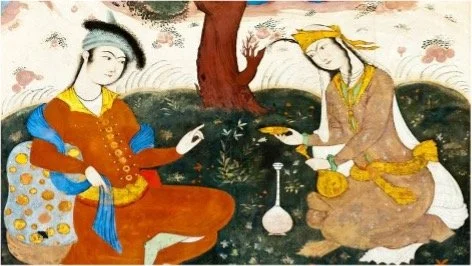
Image source: Chehel Sotoun Palace, Isfahan, Iran / Iranian School (17th c.)
The history of mankind is replete with references to love. We have read about the empires won and the wars lost because of love. We also know that a few years after Emperor Babur’s death in India, his Pashtun wife, Bibi Mubaraka, travelled from Kabul to Agra to bring his remains back to Kabul. She was motivated by the love that Babur had shown towards her—more about her story later.
So, what it is that makes people in love do impossible things? Or, what triggers the process?
In a recent issue, The Economist described love as a power that makes the world go around: a fire that can warm your heart or burn down a house; a deep sea, the greatest pleasure; infinity; blindness.
But still we are unable to explain how it is that two strangers, seeing each other across a room full of people, become nervous, their hearts start racing. Is this something we are endowed with, or just a fleeting phenomenon that has no lasting effect?
Poets, philosophers and sages have talked about love. All they could do was describe the feelings, the longing, but not why they happen. They could see the effects but could not explain the causes. They could say that love is a many-splendored thing, but couldn’t say why.
Helen Fisher, a biologic anthropologist, embarked upon a journey to unravel the secrets of love. She ran an intriguing experiment with 17 students who were freshly in love. They thought of their sweethearts all the time, and she asked them if they would die for that person. The answer was a non-hesitant and affirmative ‘yes’. She put selected students under a functional Magnetic Resonant Scanner (fMRI).
During the scanning, when showing them photos of their sweethearts, a certain part of their brains lit up. This part is in the ventral tegmental area at the base of the brain. It is where the factory that manufactures dopamine is located. It is also where Cupid resides. He has his quiver full of arrows tipped in dopamine and ready to go. Unfortunately, it is also the area that lights up in addicts hooked to food, and with addiction-causing chemicals such as cocaine, heroin, fentanyl, etc.
With the passage of time, one would think the dopamine effect might lose its pull. Two people married a few decades earlier may not show the sex drive of a younger couple, but many are still in love. How does this transition happen? We don’t know. There are couples still in love decades after receiving a dopamine-tipped arrow to their hearts. And they are still in love when sex is not part of their lives.
During his four incursions from Kabul into India, Emperor Babur had to pass through the Yousafzai territory. The warring Yousafzai Pashtuns caused him much grief by attacking his army and impeding his passage. Marriage with a young Yousafzai woman would remove obstacles from his incursion to India. So, Babur asked for the hand of a young maiden, daughter of the chief of the Yousafzai tribe. The tribe agreed, and the girl, Bibi Mubaraka, became one of Babur’s wives.
Babur had always wanted to be buried in Kabul. Indian summers were not suited to his temperament. In just his fourth year of ruling India, at age 47, he died in Agra and was buried there. Following his death, his son Humayun could not maintain control of the vast empire, and lost it to Sher Shah Suri, an Afghan king. Humayun went into exile to regroup. Babur’s family made a hurried retreat to Kabul.
Bibi Mubaraka never forgot that her husband wanted to be buried in his favourite garden in Kabul. Through her emissaries she inquired if Sher Shah Suri would allow her to go to Agra to bring the body of her husband to Kabul. Sher Shah not only permitted her and her retinue to travel to Agra, but he also facilitated the travel. It was her abiding love for her husband that compelled her to undertake the arduous journey of 1,200 km each way to fulfil her husband’s last wish.
In a remarkable long poem about the love between the Yousafzai woman and Emperor Babur, Sahibzada Riaz Noor, a Pakistani poet par excellence, wrote a poem in the voice of Bibi Mubaraka:
I brought him back
From Hind to Kabul
To lay him down
In his resting place final
Thus, did I ultimately
Requite the love he gave
In everlasting
Timeless memory
Now some poets are willing to sacrifice anything and everything for a glimpse of their beloved, or even the black mole on their cheek. Hafez Shirazi was one of those poets:
اگر آں ترک شیرازی بہ دست آرد دل ما را
بہ خال ہندوش بخشم سمرقند و بخارا را
If that Maiden of Shiraz would accept and hold my heart in her hand,
I would give away the cities of Samarkand and Bukhara for the black mole on her face
Turco-Mongol ruler, Amir Timur, had known of Hafez and his poetry. But when he heard the couplet mentioned above, he summoned Hafez to his court. It is said that Hafez, out of fear of the king, presented himself in the court dressed in ordinary clothes. Timur, in anger, demanded to know as to why Hafez was willing to give away the king’s prized cities, that he had conquered by sword, for a mere mole? To that, Hafez replied, “oh my King, I am a careless and unwise man. I have splurged and wasted my wealth to the point that I did not have decent clothes to present myself in your court.” Impressed with Hafez’s presence of mind, Timur forgave him. A two-line expression of love would have brought Hafez’s life to an abrupt and premature end.
Once again, history is replete with examples of wars being fought and lost over love. It has been suggested that Austro-Hungarian empire was defeated in WWI because General Conrad Von Holtzendorff, head of the army, was deeply in love with a married Italian woman to whom he would write daily letters during the war. He was so enamoured with her that he was not paying full attention to the war efforts. The poor devil lost on both fronts.
Every culture has its own epics of love and lament. In English, we have Romeo and Juliet. In Pashtu, we have Adam Khan and Durkhani. And in Punjabi we have the story of Heer and Ranjha. In Sindhi literature we find the tragic story of Sassi and Pannu. Here is one couplet from a 1930 Punjabi ghazal (poem) that was sung by the immortal Kundal Lal Saigal:
پنوں دل دا کھوٹا جے جھانسا نہ دیندا
تے سسی تھلی جا کے سڑدی کدی ناں
If Pannu with untrue heart would not have tricked Sassi,
She would not have died miserably in the desert of Thal
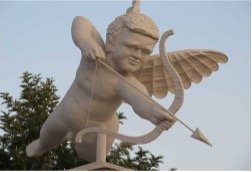
Image source: Wallpaper Flare
Love is a potent force that can move mountains or sweep anything that comes in the way by destroying it. This is not a transient or superficial phenomenon. We are hardwired for love, and the effects of dopamine on our brains are real. Very few mortals can escape Cupid’s arrows.
Love, indeed, is a many splendored thing.

Dr. Sayed Amjad Hussain holds emeritus professorship in cardiothoracic surgery in the College of Medicine and Life Sciences and emeritus professorship in the College of Arts and Letters, University of Toledo. He has been an op-ed columnist for the Toledo Blade and essayist for The Friday Times of Lahore, Pakistan