A Note From the Editors
Dear Readers,
Welcome to the sixth edition of The Lumen – an art & literary magazine of the University of Toledo College of Medicine and Life Sciences.
Launched as an initiative of the Medical Humanities Club, The Lumen embraces the role of art, history, social sciences, and literature as they pertain to medicine. This publication serves as a unique space for our community to enrich our training through the expression of the arts. As technology and research remain cornerstones of our curriculum, we aim to cultivate an appreciation for the arts and soft sciences and bring them into conversation with our education.
As editors, we are acutely aware of the privilege we have being future physicians. We will see patients seeking healthcare, not only in their times of greatest need, but also in some of the most important moments of their lives. We will bear witness to birth, death, suffering, and recovery alongside our patients. This age-old responsibility not only calls on us to recognize and treat the symptoms of our patients, but also to embrace their stories, identities, hopes, and fears – to see the fullness of their lives as essential to their care. This responsibility emphasizes the importance of the humanities in medicine; they are essential for understanding the human condition.
We hope that The Lumen can serve as a bridge between our academic and more personal experiences, as a platform amplifying voices, illuminating challenges, celebrating the creativity in our community, and reaffirming the significance of the arts in shaping compassionate, well-rounded physicians.
In medicine and biology, a lumen, as our colleagues very well know, is the innermost part of something. A lumen may house blood or bile, may carry or absorb, may empty and fill. We at The Lumen editorial board see the arts and humanities as occupying a central, luminal position in the world of medicine.
Thus, The Lumen offers us a central space: to come together, to share, to discuss, and to create.
We encourage you to contribute to future editions and to explore more of our work on our website, www.lumenmag.org. Please reach out to us at utcomls.lumen@gmail.com with any feedback or thoughts—we’d love to hear from you!
Finally, we extend our deepest thanks to our exceptional contributors, who spent their precious time creating pieces that intrigue, inspire, and empower. We are grateful for the support we’ve received from mentors, faculty, and the College. We are especially thankful to Dr. Hussain, our editor-in-chief and faculty advisor, for his constant guidance; to Dr. Matus and Dr. Kleshinski for their commitment to the medical humanities; and lastly to Dean Ali for his generous support.
The Lumen Editorial Board
Lena Bercz, MS4
Zainab Lughmani, MS3
Jack Newman, MS3
Solee Cheon, MS3
Meghana Sugoor, MS2
Alsedeaq Hawamdeh, MS2
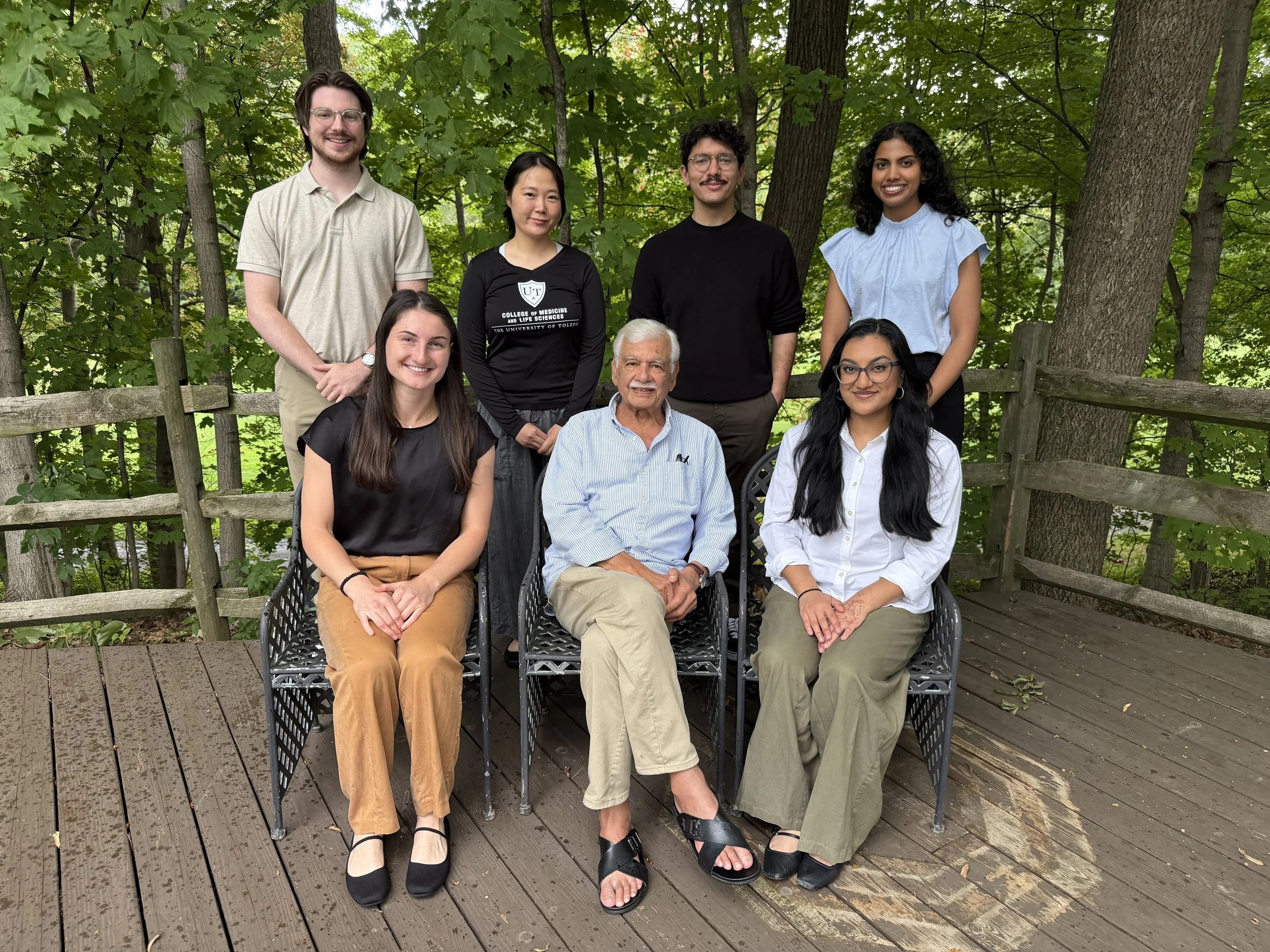
Back — Left to Right: Jack Newman, Solee Cheon, Alsedeaq Hawamdeh, Meghana Sugoor
Front — Left to Right: Lena Bercz, Dr. S. Amjad Hussain, Zainab Lughmani
Issue 006,
Fall/Winter 2026
Editor-In-Chief:
Dr. Sayed Amjad Hussain, MD
Editorial Board:
Lena Bercz, MS4
Zainab Lughmani, MS3
Jack Newman, MS3
Solee Cheon, MS3
Meghana Sugoor, MS2
Alsedeaq Hawamdeh, MS2
Art Consultant
Adam Levine, PhD
Edward Drummond and Florence Scott Libbey, Director, President and CEO of the Toledo Museum of Art
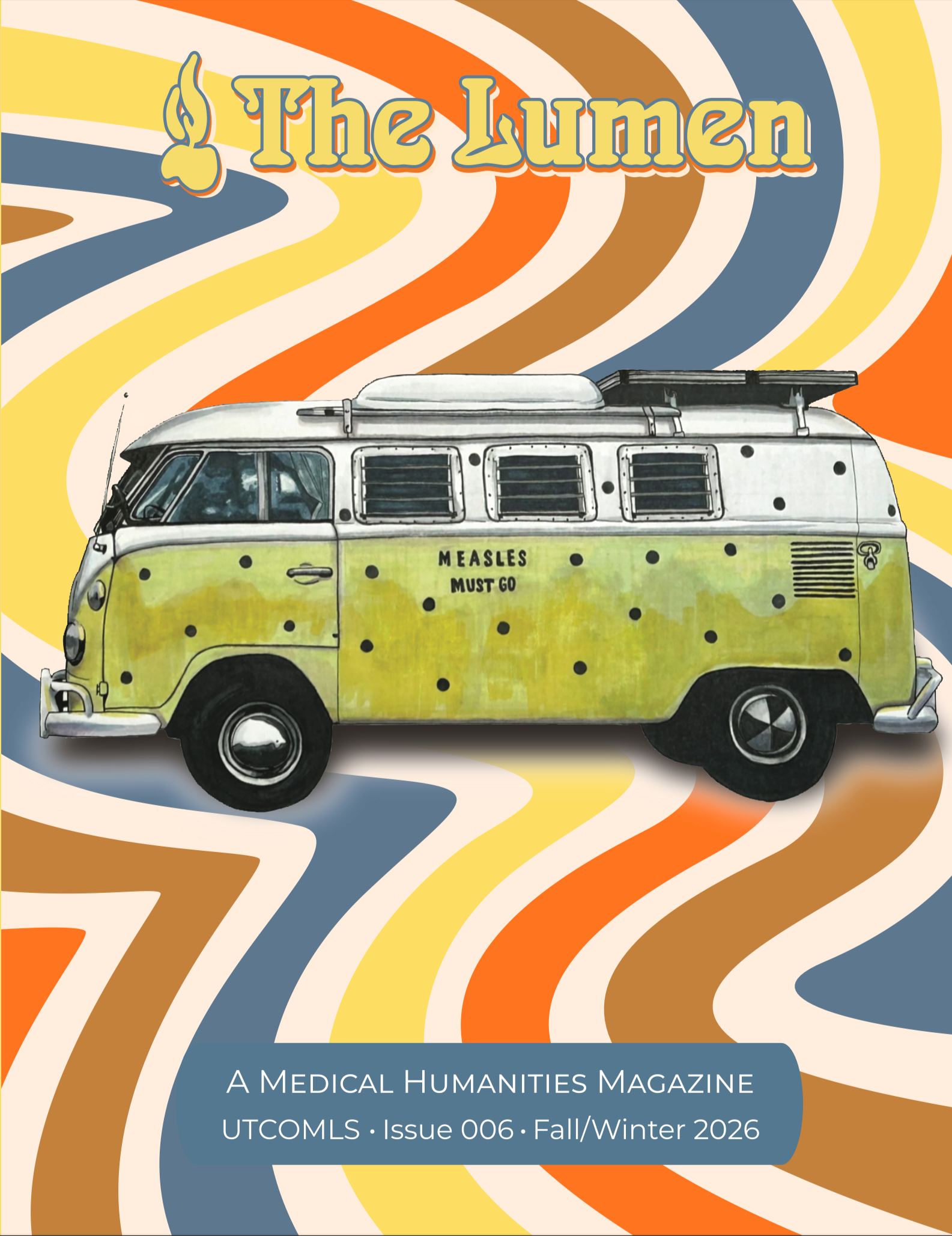
Cover Art: The featured cover art is derived from the original piece “Measles Must Go” by Emery Sandler which can be found in the table of contents.
Editorial
From Dr. S. Amjad Hussain
The matters of heart and head
This is the 6th issue of the Lumen. Its initial hesitant steps have now morphed over time into confident strides. With the passage of time, it has matured and become more meaningful. It took many hands to bring it to the present juncture.
I am most grateful to former Dean of the College of Medicine and Life Sciences, Professor Christopher Cooper, and current Dean, Professor Imran Ali, both of whom have been enthusiastic supporters of this magazine. Their moral and financial support made it possible for students to bring forth their literary and artistic talents to prove that the humanities have been an integral part of the study and practice of medicine.
When I entered medical school in Pakistan 69 years ago (has it been that long?) the prevailing wisdom was to abandon all extracurricular activities and concentrate on the studies at hand: no sports, no literature, no plays. It was hard to go against the tide. I was, however, not about to abandon my other interests just because I was awarded a coveted spot in medical school. I soon realized that extracurricular activities were essential to my medical studies if I could juggle my priorities and manage my time efficiently.
A cursory look at the Lumen shows that most medical students do find time to be creative whether in sports, literature or any other areas of human endeavor. In every era there have been physician poets, writers and artists. This is precisely what Sir William Osler, the great Canadian physician and teacher, (1849-1919) advised his students:
While medicine is to be your vocation, or calling, see to it that you have also an avocation- some intellectual pastime which may serve to keep you in touch with the world of art, science, or of letters.
He also said:
A physician may possess the science of Harvey and the art of Sydenham, and yet there may be lacking in him those finer qualities of heart and head which count for so much in life.
Unfortunately, the connection between science and the qualities of heart and head is not taught, publicized, or emphasized. And still, we have excellent writers, poets and artists among our medical students. Just a glance at the contents of our magazine would drive that point home.
Under the leadership of Dean Ali, the medical school has created various pathways to supplement medical education, including one for the humanities. This year, the first group of these pathways was admitted, and we hope this will create synergy between our magazine and the humanities club on campus.
Our Student Editorial Board consists of talented and enthusiastic students from 1st to 4th years. They bring an outlook that is fresh, passionate, and exuberant. While selecting the contents for the Lumen, we discuss, debate and occasionally disagree. We are now even looking into including a few pieces of performing arts in future issues.
When introducing the iPad in 2010, Steve Jobs famously said:
It is in Apple DNA that technology alone is not enough. It is technology married with liberal arts, married with the humanities that yields the results that make our hearts sing.
Including performing arts pieces in the Lumen would really make our hearts sing.
Adios until the next issue.
S. Amjad Hussain MD
Editor-in-Chief
A Message from Dr. Imran Ali
The practice of medicine is an art. Medicine is based on most often, very well-defined principles and processes that provide guidance to physicians on how to treat diseases. However, the true practice of medicine requires communicating and conveying empathy, kindness and genuine concern for the who are sick and their loved ones. The link between science and art becomes clear as one starts to practice medicine. Conveying a difficult diagnosis, a complex management plan or most crucially, diagnostic uncertainty requires humility, moral clarity and respect for others. The study of art and humanities brings us closer to that goal. How we express ourselves and how we perceive others requires us to connect science and literature and that connection leads to our practice of medicine becoming the art of medicine.
The 6th edition of the Lumen provides an opportunity to understand how literature and medicine intersect in a meaningful way and make us better at what we do.
I am grateful to Dr. Husain, Dr. Matus, the authors and the student editors’ remarkable effort. We truly appreciate their hard work and the insight this magazine provides with each new issue.
Sincerely,
Imran Ali MD
Dean and Vice Provost for Health Education
Professor of Neurology
University of Toledo, COMLS
Table of Contents
The Space Between the Cracks — by Lena Bercz
Overheard Pt 1 — by Solee Cheon
Overheard Pt 2 — by Solee Cheon
Bones in Bloom — by Dr. Kate Szymanski
The Life I Was Supposed to Live — by Mona Khalafi
A Patient Story: Plaque Pas de Deux — by Sid Fernandes
Chains of Fiber — by Jack Newman
The Vessel — by Vivien Holop
Anatomical Ceramics — by Vivien Holop
The Witness — by Vivien Holop
Clinical Vignette — by Michaela Witt
Witness to Becoming — by Lila Mahmoud
The Tomorrow Test — by Jude Crittenden
Measles Must Go — by Emery Sandler
Borken Economy — by Solee Cheon
The Great Dissector — by Nathan Hershberger
Peace Admist Chaos — by Mary Grace Hamiln
The Dean of Bezoars — by Thom Hawkins
After Pieter Claesz — by Vivien Holop
Turning 85 — by Dr. Lloyd Jacobs
Between the Rooms — by Shreyas Banerjee
Poems in Tandem: Loss and Recovery — by Jeana Shafer
Professionalism in Practice — Varsha Vedapudi
A Perfect Day for Dying - by Dr. Lloyd Jacobs
Love is a Many Splendored Thing — by Dr. S. Amjad Hussain
The Spaces Between the Cracks
by Lena Bercz
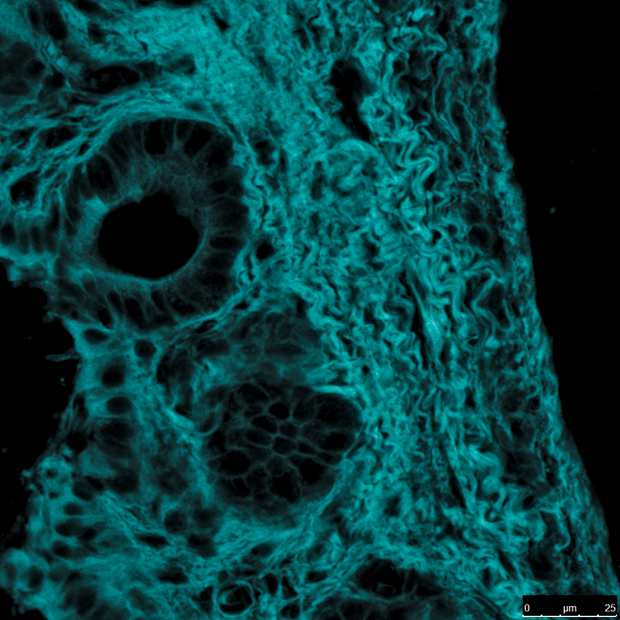
Image displaying the interstitium within a rat extrahepatic bile duct, captured by Dr. Rebecca Wells using second-harmonic generation microscopy. In blue, collagen bundles making up the support structure can be visualized, and the black gaps represent spaces containing cells, carbohydrate residues, and free-flowing fluid.
Humans are wired to seek answers. It’s in our nature to explain and systematize the world around us, shaping our understanding into neat frameworks we call “facts”. This instinct is deeply comforting and provides us with a sense of control in an unpredictable world. This is an incredible strength of ours, setting us apart from other species. In science, this way of thinking has led to unbelievable discoveries, from mapping the cosmos to decoding the human genome. However, can this drive be a double-edged sword, blinding us from possibilities that don’t fit within our established way of thinking?
Medicine, as any scientific discipline, is built on a foundation of evidence and logic. However, as it is shaped by human minds, it is not exempt from the blind spots and biases that we inherently carry with us. This brings us to one of the most fascinating medical discoveries of recent years: The Interstitium, a newly classified human organ system that was hiding in plain sight.
In 2018, a team of pathologists at New York University led by Dr. Neil Theise, was studying a bile duct when they discovered a peculiar honeycomb-like network of small holes lining the organ. After further investigation, it was found that this structure is not limited to the bile duct – it lines almost all organs and spaces in the body and is present throughout connective tissue, containing fluid rich in nutrients and proteins. This vast network functions as a “highway system”, allowing for the flow of fluid across the body, interconnecting all organ systems and spaces. Despite interstitial space being a known structure in the medical world, it has been previously misunderstood as dense, solid connective tissue merely making up the “space” between organs, rather than a dynamic fluid-filled network (1).
This entity has been found to be immensely significant, containing over 25% of the body’s fluid – over four times the amount of fluid found within the cardiovascular system. Fittingly speaking to its role as an in-between space, this “new organ system” was named The Interstitium. Further research has shown that the interstitium plays a prominent role in molecule transport and shock absorption. It was also found to be a crucial piece of the puzzle in processes we haven’t well understood including chronic pain, cancer metastasis, and the way our bodies store trauma (2). Despite its exciting implications in medicine, one of the most interesting aspects about the interstitium is that it was discovered so late. It remained unrecognized for so long, not because we lacked the technology or knowledge to uncover it, but because our beliefs stood in the way of our perception of it.
For centuries, microscopy specimens have been processed by being sliced thin and dried out using special techniques. In doing so, interstitial spaces collapse and appear in the form of cracks under the microscope. Previously, when cracks were observed, they were written off as trivial products of the sample preparation process, instead of ever prompting a second thought or being questioned as a potential clue into an unseen system. Notably, the interstitium is so large that it can be appreciated with the naked eye during dissection, yet it went unquestioned as it did not fit within the framework that we had long accepted for how anatomy should look (1).
The story of the interstitium teaches us an uncomfortable yet imperative lesson: Our deeply held beliefs can blind us from truths that might be right in front of us. The categorizations that we use to make sense of our world may limit our perceptions of it, even in fields as disciplined as science.
Beyond this, the interstitium demonstrates how rigid thinking hinders progress and urges us to consider the coexistence of multiple truths. One of the most fascinating aspects of the interstitium is that it hints at a bridge between different philosophies of medicine that have long dismissed each other. Western medicine, built on a foundation of evidence-based practice grounded in principles of biochemistry, physiology and anatomy, has long rejected traditional Eastern practices, such as acupuncture, due to their mechanisms not aligning with Western models. In contrast, Eastern medicine has traditionally emphasized the movement of energy throughout the body – known as chi – offering a more holistic and intuitive approach.
Although further research is warranted, it has been suggested in the literature that the newly described interstitium, allowing for the flow of energy and fluid throughout the body, likely plays a role in traditional Eastern medicine practices, grounded in the concept of chi, that have been around for centuries (3). This reminds us of an essential truth – phenomena dismissed as unexplainable may simply reflect gaps in our current understanding. Just as light is both a particle and a wave, different ways of thinking can highlight different aspects of medicine and may coexist. Perhaps both approaches offer a piece of a larger puzzle and dismissing one because it does not neatly fit into the other’s framework is a mistake born of arrogance.
As a third-year medical student navigating clinical rotations, learning the craft of diagnosis and treatment plans through scientific reasoning, the story of the interstitium captivated me in a grounding yet unsettling way. It serves as a humbling reminder that the human body, let alone the world around us, is far more complex than we currently understand and most certainly ever will. It reinforces the importance of embracing the unknown and being willing to question even the most fundamental understandings. The interstitium urges us to remain open to different perspectives, even if they seem to challenge our own, and accept that our understandings are rarely the final word, rather, pieces of a larger understanding.
Questioning ideas is not a threat to science; it is the very essence of it. The path forward lies in curiosity, humility, and willingness to recognize that there is always more to learn.
Sources:
Rettner, R., & LiveScience. (2018, March 27). Meet your interstitium, a newfound “organ.” Scientific American.
Benias, P.C., Wells, R.G., Sackey-Aboagye, B. et al. Structure and Distribution of an Unrecognized Interstitium in Human Tissues. Sci Rep8, 4947 (2018). https://doi.org/10.1038/s41598-018-23062-6
Tomov N, Atanasova D, Dimitrov N. Is the Newly Described Interstitial Network the Anatomical Basis of Acupuncture Meridians? A Commentary. Anat Rec (Hoboken). 2020 Aug;303(8):2169-2170. doi: 10.1002/ar.24114. Epub 2019 Apr 9. PMID: 30874366.
The space between. (2018, October 10). IEEE Pulse.
Lena Bercz is a fourth-year medical student at UTCOMLS.
Overheard Pt 1
by Solee Cheon
This is what I overheard today. The blue sky seemed down. They say that an apple a
day keeps the doctor away. But she died. I wonder what her family thought when the
police showed up. No one took her body away. There isn’t any space left. We don’t
have space for the living. Leave the dead outside. The two police open the door and we
all look.
look.
look at the death.
“Turn on the A.C. so her body doesn’t start to smell.”
Solee Cheon is a third-year medical student at the UTCOMLS.
Overheard Pt 2
by Solee Cheon
I overhear a familiar line. A scene told in two parts.
“It’s cancer.”
Where is the linearity. I am told that I am only dust and only temporal.
“How much time do I have left?”
Questions which arise from every corner of a mouth. Did you see her eyebrows touch together. Statements and questions sometimes vary only by a tone.
Pause here.
The treadmill slows down enough for me to get off.
“I don’t know what to do from now on.”
Round eyes glance around for a reprieve, but this is a land of sharp pixels only.
“We’ll figure something out.”
Words that placate no one but the sayer. I remember a sharp feeling and follow that red line.
“ja ki yah.”
A mating call. Let it go to voicemail. Caller ID reads unknown.
“Are you afraid?”
I guess that’s how I feel about foreign substances. Fear smells like something expired, curdled. Tastes strange too. Here - I call on an ancestor. Milkmaid of mars. A white curl of anger.
“What do we do?”
A bird flies by. Talks strong and mighty. Chirp, Chirp, Chirp. The spring breeze weaves in and out and in-between.
“I don’t have an answer for you.”
Solee Cheon is a third-year medical student at the UTCOMLS.
Bones in Bloom
by Dr. Kate Szymanski
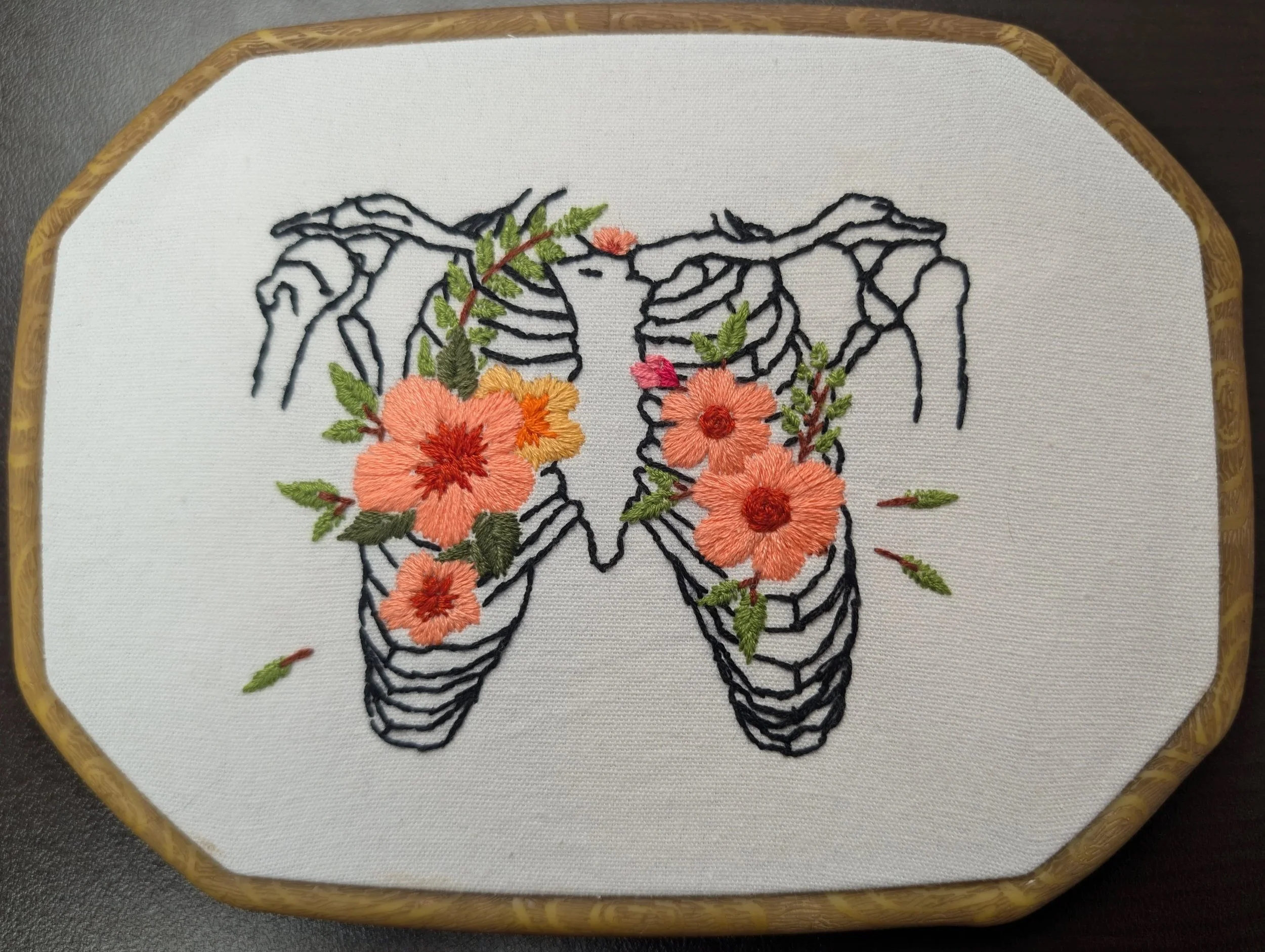
Artist’s Statement:
I enjoyed making this as it was a way to balance my joy in anatomy and embroidery. I loved that the flowers were where the lungs would be located. It felt symbolic of the need to balance our lives with the natural world for healthy air for us to breathe.
Dr. Kate Syzmanski is an Associate Professor of Family Medicine and Geriatric Medicine in the Department of Family Medicine at the UTCOMLS.
The Life I was Supposed to Live
by Mona Khalafi

Image source: @earth on Instagram
“I never wanted to leave my home.”
These words from my father shocked me. Like most immigrants, my parents left for opportunity, safety, and for a life they could only imagine for me and my brother. I began to picture the life I would have lived had the Iranian revolution gone a different way. But what of the life that could have been? A childhood, summers, streets and bazaars now frozen in time.
December 28th: The headlines read: Bazaars in Iran have closed. Inflation reaches its limits.
I was across the world that day, leaning on the railing of my balcony in a different country. My family and I traveled on vacation with friends from the Iranian diaspora who have become our family in the United States. Meanwhile, my relatives waited for news thousands of miles away.
It has been over ten years since my last visit, a strange feeling after spending summers in Iran that once shaped my childhood.
January 8: Complete blackout. The entire country had gone silent after services were cut off while protests were escalating. Reaching a peak and point of no return.
I had my OSCE and lectures on ear infections, nutrition, and back pain. Life continued in microcosm, oblivious to the rupture happening half a world away.
January 9th: silence.
I went to lecture, then nursed a headache. A quiet ache that seemed to stretch across oceans.
January 10th: Smuggled devices brought affidavits from those still in the country. Weapons have started to be used against protestors. Mortality was predicted to be 200.
I was unproductive that Saturday. Quiet and mediocre for me while their history could not pause. January 11th: The death toll drastically rose to 2,000. Foreign aid was urged.
I did 60 practice questions, caught between my life moving forward while others were fighting for a turning point in theirs.
January 12: 100 hours without internet. Some devices slipped through Starlink. The words were morbid and raw: “They just kept killing.”
I spent 11 hours in the clinic seeing people’s grandparents, aunts, uncles, cousins, while we had not heard from mine in those 5 days. Out of reach.
As the days pass differently for us, I held the quiet of their struggle alongside the life I continued to live, carrying a reminder that these multiple realities have shaped the life I live.
In the depth of clerkships, life does not stop. Medicine brings me to the intersection of this feeling, where we are reminded to witness, to carry, and to remain human; fragile, aware, and attentive to the lives we touch.
Somewhere between here and home, I feel the pulse of a future that could have been, the life I was supposed to live.
Mona Khalafi is a fourth-year medical student at the UTCOMLS.
A Patient Story: Plaque Pas de Deux
by Sid Fernandes
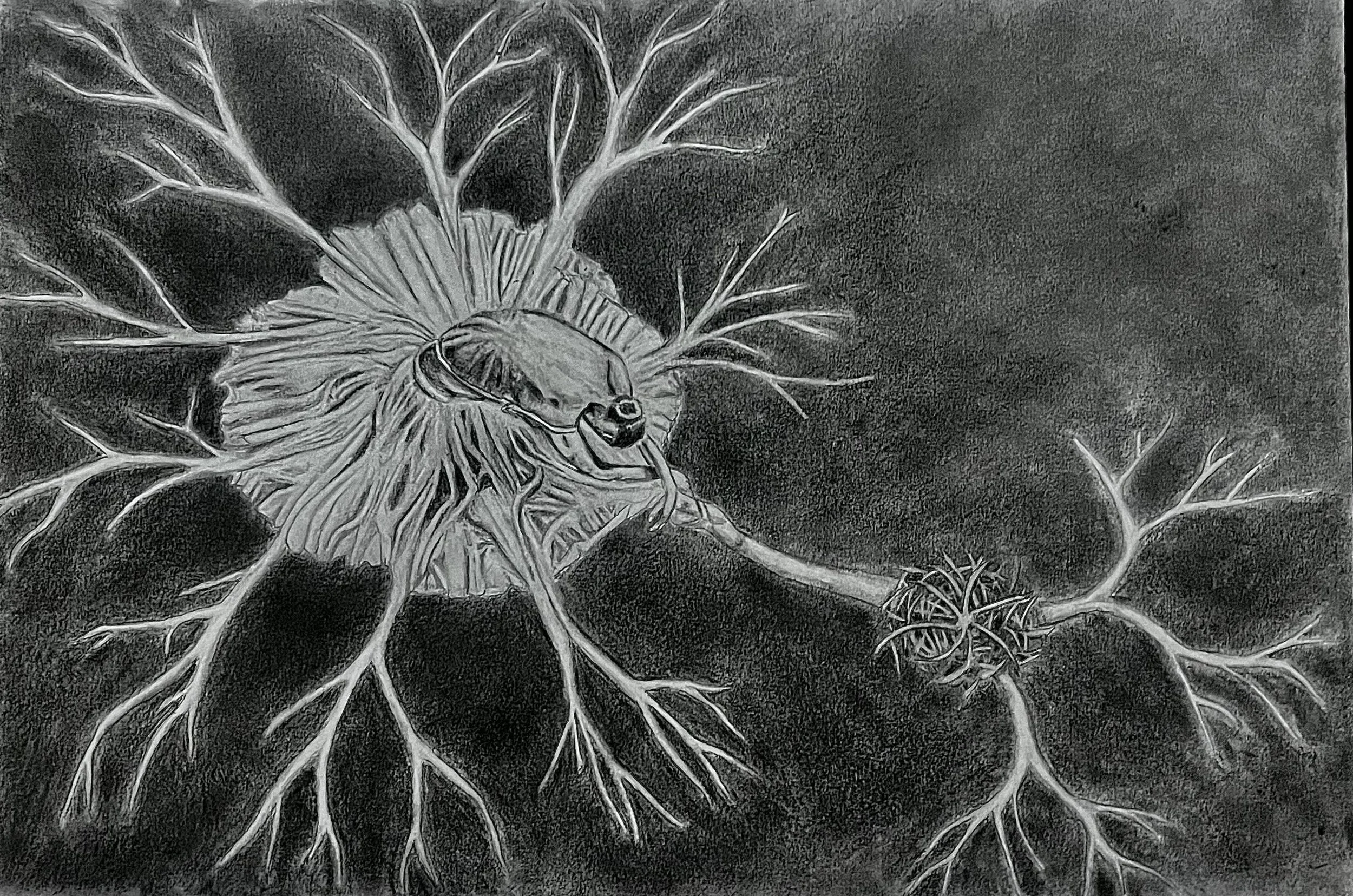
Artist’s Statement:
This piece was inspired by a patient, who was a retired ballet dancer with Alzheimer's. When her family played Tchaikovsky's Swan Lake theme, it had reawakened gestures from her dance, demonstrating how movement and sound remained intertwined in her memory and identity as an artist. In this piece, the dancer is positioned in what is known as the “dying swan pose.” Her silhouette resembles the shape of a neuron with her tutu as the soma and her limbs as the dendrites and axon. A cluster of beta-amyloid plaque, however, interferes and blocks further branching.
Sid Fernandes is a second-year medical student at the UTCOMLS.
Chains of Fiber
by Jack Newman
Independent as you were, a shame, a curse, you must endure,
Incarcerated, not without, a web within to steal your shouts,
And the very air you used to sigh, and laugh, and gasp, and yell, and cry,
And climb, and crawl, and work, and fly. Idiopathic? Don’t be shy–
You take and take and leave to die, rigid to the reason why,
Honeycombing ventilation, interstitial desperation,
Not sweet, just sticky, constrictive, quickly,
Running out of words to say,
And breath to give, and time to stay,
Sprinting, jogging, walking, slowing,
Stopping doesn’t end the choking,
Mercurial, you fibers wind,
To bind the lungs, to snare the mind,
When some lament scars on their skin,
Envisage them from deep within,
Inhale the world and hold it in,
Count the seconds, now do it again,
Now do it again, now do it again,
Don’t think of freedom only when,
It’s stolen from you, or him, or them,
Surrounding us, a ceaseless din,
Six hundred, or so, million of them,
But end they do, breath of life,
A twisting, gnawing, cellular knife,
Stuck within your own repair,
A trap they laid,
For the very air,
Once so delicate,
When first you cried,
Five lobes now hardened,
Still keep their pride, so–
Freely.
Inspire.
Before.
Restriction.
Only.
Stillness.
Is.
Sufficient.
-Inspired by those, like my grandfather, who live with chronic interstitial lung disease-
Jack Newman is a third-year medical student at the UTCOMLS.
The Vessel
by Vivien Holop
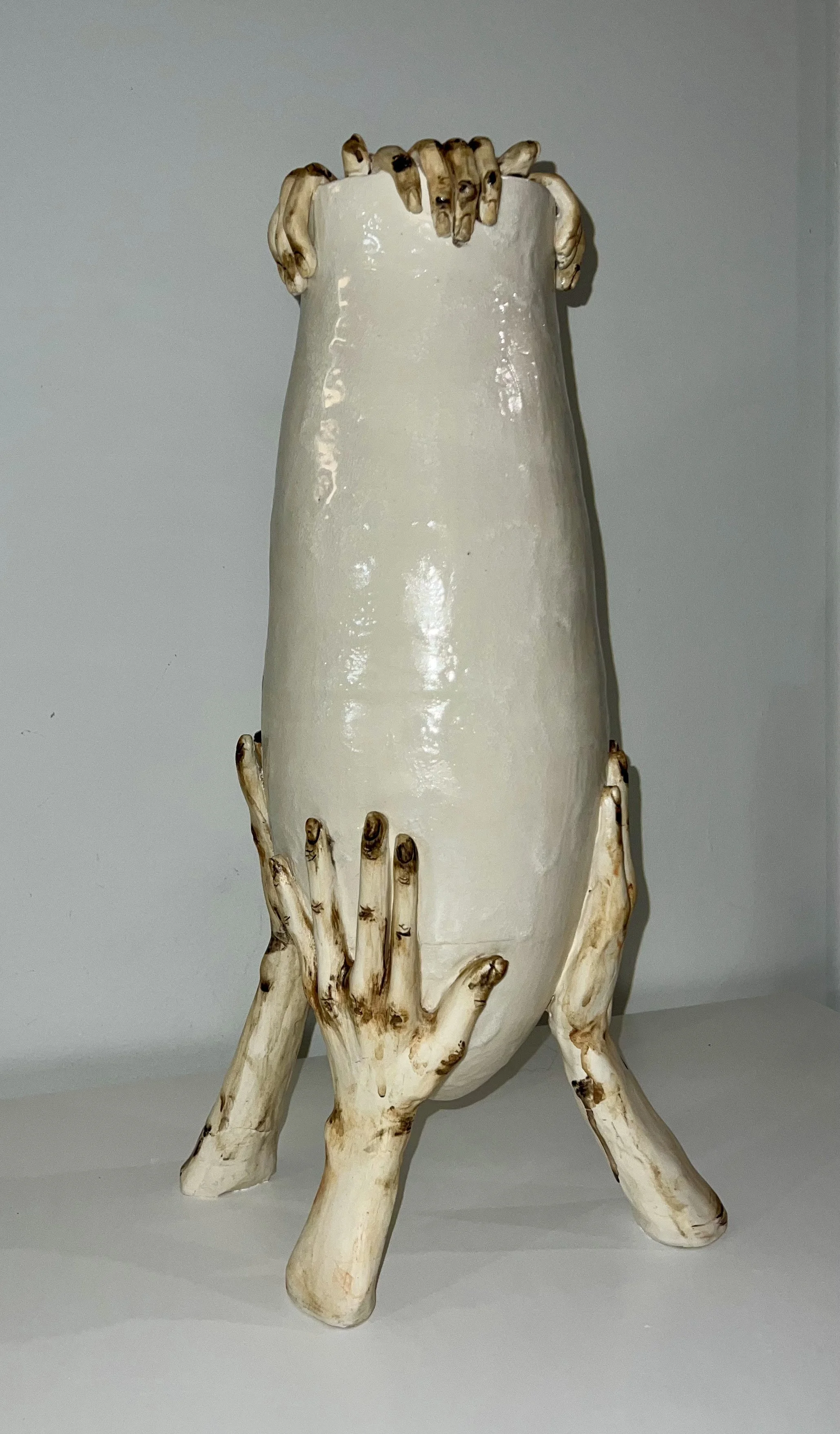
Artist’s Statement:
This sculpture explores containment as both protection and restraint.
The smooth, sealed body contrasts with anatomically rendered hands that grasp, brace, and hold the form in place. The purpose of these hands is to contrast care with desperation, the impulse to preserve something fragile while preventing its escape.
The vessel references the attempt at stabilization of impermanent life by echoing medical, religious, and archival traditions of the body. The work resists transparency and certainty by denying access to the interior, inviting discomfort around what is hidden, stored, or withheld.
My work asks the viewer whether containment is an act of care, control, or fear. To analyze whether something kept intact is truly protected, or simply postponing the inevitable.
Vivien Holop is a second-year medical student at UTCOMLS.
Anatomical Ceramics
by Vivien Holop
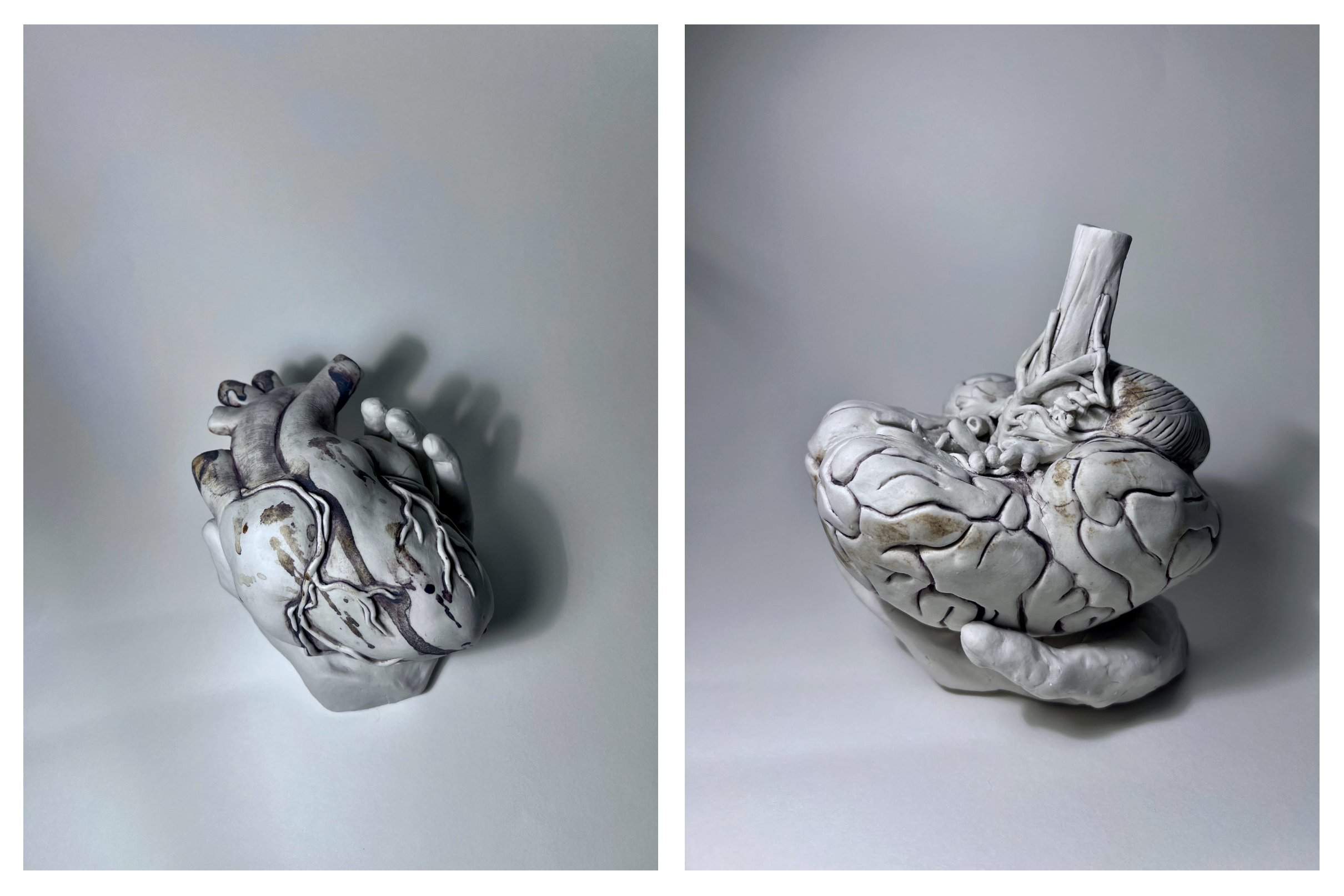
Artist’s Statement:
These ceramic forms reinterpret anatomical structures as objects of care rather than instruction. By removing them from their clinical context, they become vulnerable and tactile forms.
My surface work aims to capture both medical illustrations and organic decay, emphasizing the never-ending tension between precision and fragility. They encourage the audience to consider the intimacy of the human body, while inviting viewers to contemplate how understanding and handling it can become both reverence and intrusion.
By presenting these organs as sculptures rather than diagrams, they challenge the neutrality often associated with the dissection of human bodies and anatomical knowledge, to question how empathy survives when the body is fragmented for knowledge.
Vivien Holop is a second-year medical student at UTCOMLS.
The Witness
by Vivien Holop
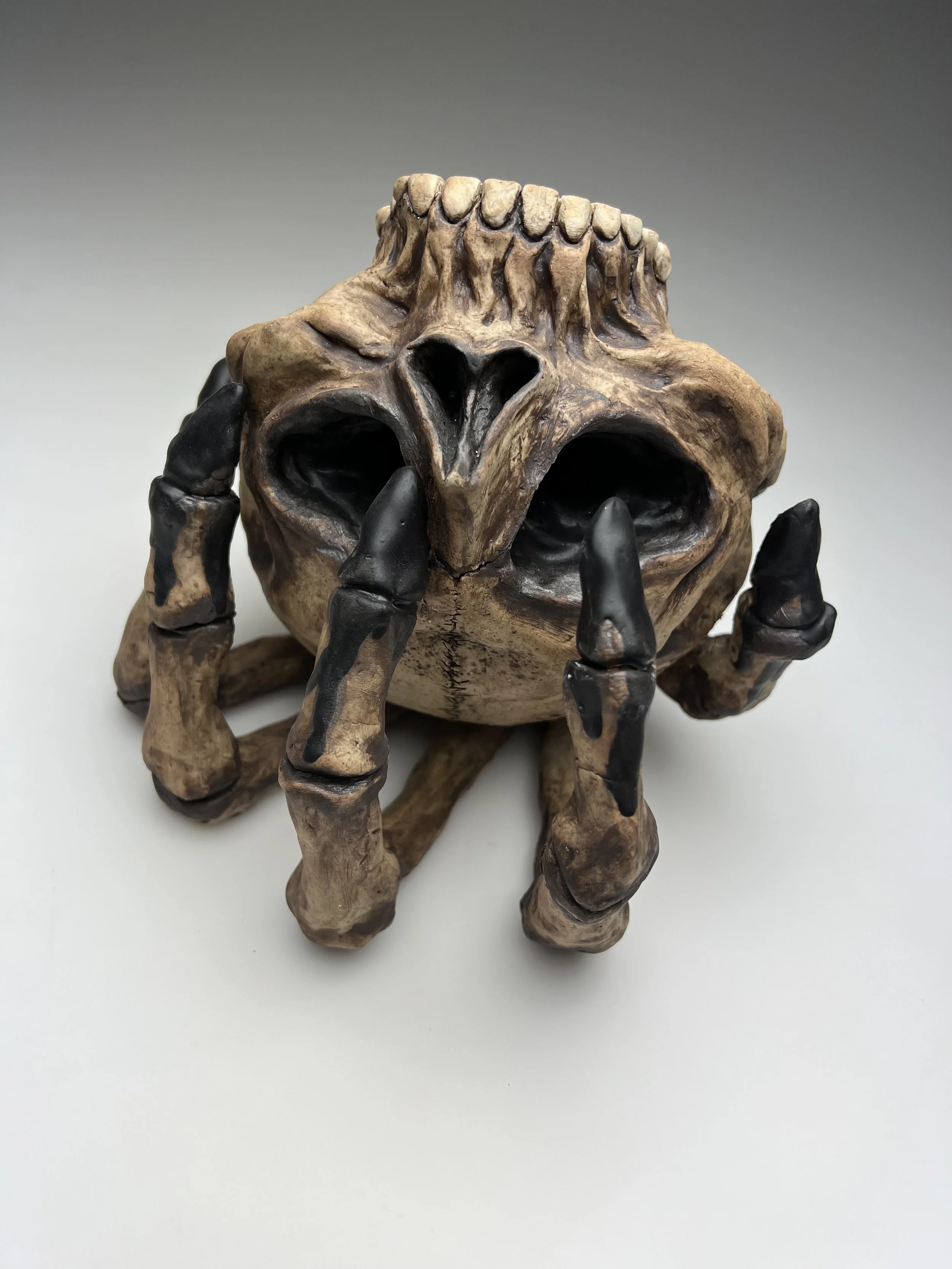
Artist’s Statement:
This sculpture represents a creature that exists in a state of everlasting observation.
The exaggerated eye sockets of the skull emphasize perception over identity. The work positions the act of looking as predatory: exploiting the body and taking information without consent; vulnerable: recognition of discomfort and one's mortality; and unavoidable: the natural human urge to perceive. These qualities suggest that to witness is also to be involved.
Vivien Holop is a second-year medical student at UTCOMLS.
Clinical Vignette

Image source: Unsplash
by Michaela Witt
i saw myself today for the first time
in a clinical vignette.
a 24 year old Caucasian female…
i forget the rest, but six words were enough.
i wondered: does she have a favorite color?
a favorite recipe? a faded nighttime stuffed animal companion?
i do.
silver, cinnamon rolls, and a tarantula. i want you to know.
does she have a name? she must, but
the vignette didn’t mention it.
we looked at her symptoms.
we looked at the multiple choice answers; there were five of them.
five solutions to a problem, five boxes, five categories.
A B C D or E.
are any of those letters in her name?
three of them are in mine.
she could be me.
we picked an answer and defined our nameless patient by a disease.
i don’t remember if we were right, or wrong.
all i know is that i saw myself today
for the first time
in a clinical vignette.
Michaela Witt is a third-year medical student at NEOMED.
Witness to Becoming
by Lila Mahmoud
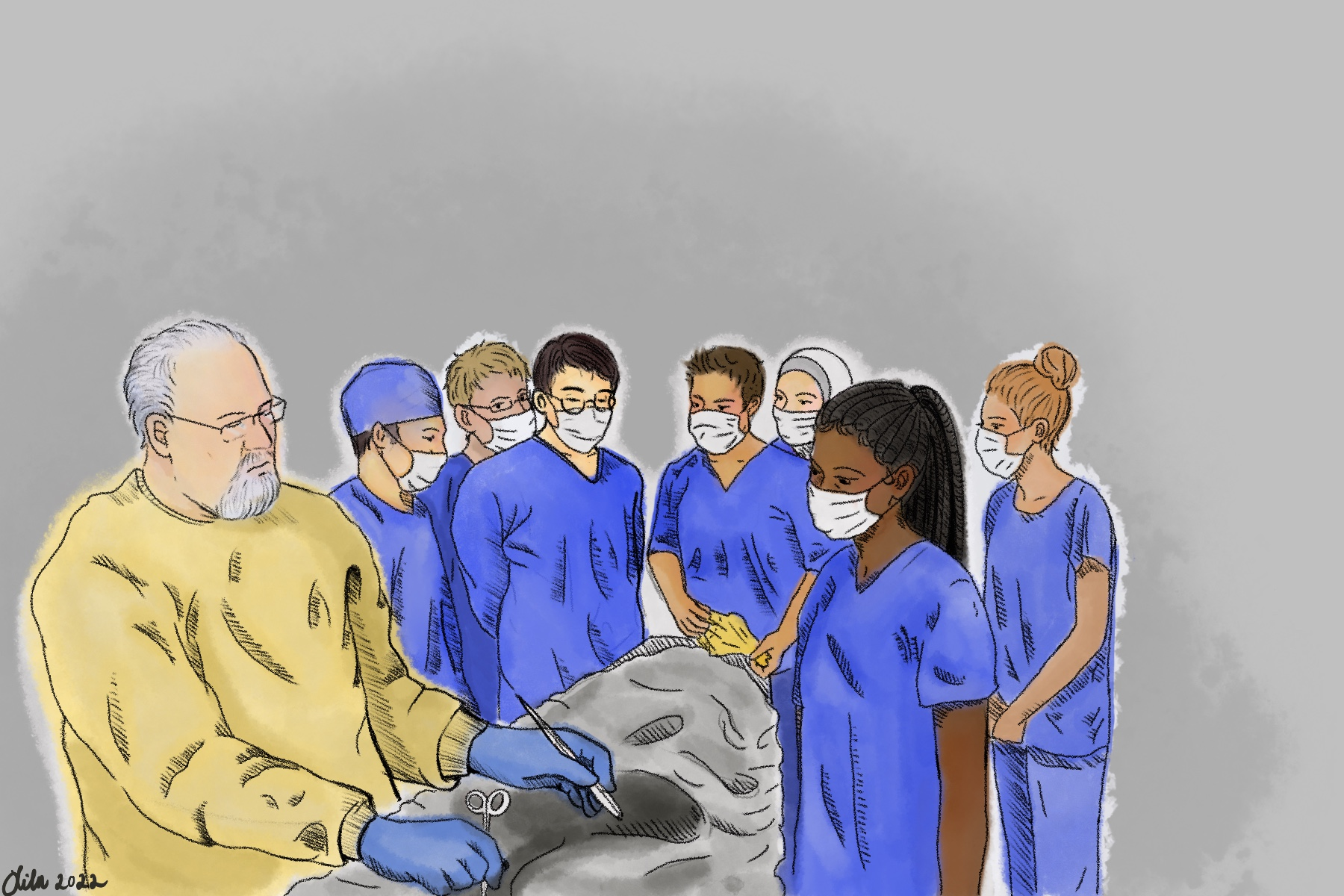
Artist’s Statement:
This piece was created as a tribute to Dr. Patrick Frank Williams, a skilled anatomist and former Assistant Professor at UTMC. During my undergraduate years, I reached out to him in hopes of getting involved in research, and he generously allowed me to enroll in his research elective. Through this experience, I was given the rare opportunity to explore the anatomy of my choosing, and as an artist, I felt it was only natural to study the brachial plexus.
It was in this lab that I first watched Dr. Frank teach medical students, quietly hoping that I would one day stand among them. In what could have been an intimidating environment, he met myself and others with kindness, guidance, and warmth. He taught me not only how to study anatomy, but how to appreciate it, to approach the human body with respect, curiosity, and awe.
This piece captures those moments, scenes etched into my memory that reflect the precision, skill, and quiet artistry of his teaching.
Lila Mahmoud is a second-year medical student at UTCOMLS.
The Tomorrow Test
A Personal Case Study with Societal Ramifications- The Death of My Dad.
by Jude Crittenden
Preface
There are a few important and universally acknowledged truths that we all learn throughout life. Gravity – when we fall down, it hurts. Mothers – they love us all the time but only like us some of the time. Dogs become your proxy children when your actual, human kids grow up and leave the house.
And once we turn sixty, a universal truth that was previously abstract becomes concrete and self-evident; we recognize that we all get old and will, eventually, die.
Death becomes a stark and vivid reality when we watch our parents age, grow infirm and pass away. And, once an elderly parent does die, it’s normal to become self-reflective and look at an experience that you once thought abstract and personalize it from your own perspective.
My father Wayne recently died. And I did, indeed, get reflective. But, I didn’t just reflect on his life and death, I looked at the wide sweep of his quickly growing age cohort from an outside societal vantage. Wayne began an inevitable transition from a robust, energetic and proud man and descended down a slope towards physical degradation and mental confusion.
If the toll this downward journey took on Wayne wasn’t enough, the inherent financial costs borne by everyone else for Wayne’s unwanted and terrible remaining years were…more than catastrophic.
A quick Google AI search resulted in the following:
The budgetary problem faced by medical and related care for aging baby boomers is considered very extensive, with a significant impact on healthcare systems due to the large size of the generation and their increased need for chronic disease management and long-term care as they age, leading to rising healthcare costs across the board; experts predict this issue will become increasingly problematic as more boomers reach retirement age and require more intensive medical services.
Just below this description on my computer screen yielded a link to the National Institute of Health’s research piece titled The 2030 Problem: Caring for Aging Baby Boomers . The NIH report focused on the “aging shocks” we’re now facing pertaining to, in their words, the challenges related to caring for seniors that need to be faced by society (NIH, August 2002).
Questions then followed that, I don’t think we have answers for nor have we, as a society, prepared to deal with.
And the consequences are now front and center.
So, what’s to be done?
Essay
Around the time the American Colonies were fighting the British Crown for independence, the Englishman Jeremy Bentham was developing his axiomatic philosophical theory: utilitarianism. Bentham’s utilitarian principle stated that “it is the greatest happiness of the greatest number that is the measure of right and wrong.”
When Cato the Younger, a Roman Republican, realized that Julius Caesar had bested him in Rome’s civil war, …”Cato discussed with his friends at dinner the Stoic belief that a truly free man would never become a slave.” Recognizing that he was, by that day’s standard, an old man at 50 who had lived a long life according to his own beliefs, Cato committed suicide rather than suffer the indignities he was to face at the hand of Julius Caesar. He was also hesitant to lose his dignity and gravitas to the degradations of old age and decline. Slavery, either to old age or Caesar’s rule, was not an option.
In 1991 a Midwestern firefighter named Wayne, just shy of his 60th birthday, gathered his children and had a first and last family conclave. A decade earlier, in his forties, the husband Wayne, dutifully tended to his wife during her three year long, ultimately futile, battle with cancer. In his fifties Wayne cared for his mother during her seven year long struggle with Alzheimer’s. Wayne watched his wife, brother, mother and father die from the ignoble and grotesque consequences of cancer and old age infirmities.
Wayne, my dad, voiced a commitment to his three young adult children, that he would commit suicide when he thought his dignity, purpose and reason for living slipped away.
Dad vowed to not be a burden to those he loved and, more importantly, he was committed to dying with dignity. He casually and poignantly remarked: “We allow our dogs to die, pain free, with dignity and speed yet we torture our loved ones at the end of their lives.”
Unfortunately, years later at age 80, when dad’s dignity, purpose and reason for living started slipping away, he was asked the question: “What is your 1, 3 & 5 year plan now that you have crossed the Rubicon and are sliding into the degraded stage of life you detested as a younger man?”
With vacant eyes and diminished faculties, Wayne had no response. He could no longer understand the dimensions inherent in the simple yet complex question. Dad simply answered: “My perspective has changed.”
Now dad is confined to a bed, wearing diapers and riddled with pressure ulcers requiring daily tending. Wayne has no dignity, no purpose and no reason for living. He is a prisoner to the medical and caregiving establishment that profits greatly from our modern day’s increased life expectancies. The ravages of time have intervened to strip him of the ending he desired only twenty years ago: A death with dignity at the end of a purpose driven life.
Furthermore, his continued existence is costly to taxpayers, younger Americans and society at large; a crushing expense borne by those who can ill afford to pay for the care of their increasingly infirm elderly loved ones.
How did this all come to pass? How is dad’s present life being lived in direct opposition to Bentham’s utilitarian principles? How did his Stoic dignity slip away?
A famous mathematician / intellectual, whose name I’ve long forgotten, once said (paraphrased to the best of my memory), “A hundred years ago we died painfully, quickly and with dignity. Today we die painfully, slowly and without dignity.”
Today, one in six Americans are over 65 years old; 17% of the population. By 2040, 22% of the population in America will be collecting Social Security and using Medicare. 25% of all Medicare spending occurs within a patient’s last 12 months of life. And these last months typically find an elderly Medicare recipient under hospice care and, by any qualitative measure, subsisting in a completely ghastly state of existence.
With this all said, a unique utilitarian theory conundrum presents itself: How does society educate our young, maintain infrastructure, find solutions for Climate Change, research cures for cancer, explore outer space…in short, build futures for tomorrow’s children while we are spending a king’s ransom on keeping our elderly loved ones alive well past their due date?
Furthermore, from a Stoic vantage, the enormous sums being spent on providing life-extending medical care and then warehousing older persons, many times against their wishes, creates an ethical paradox where our elderly family members and friends are living a life they would not choose to live otherwise.
How, with limited resources, do we make tomorrow better for those under 65 while being ethical, caring and supportive of those over 65?
eu·tha·na·sia (self-determined)
noun
the painless killing of a patient suffering from an incurable and painful disease or in an irreversible coma.
Euthanasia has been frowned upon by western societies in modern times. Euthanasia brings up memories of the eugenics movements of the last century. Works of science fiction are replete with societally enforced methods of euthanasia. In Harry Harrison’s 1966 book “Make Room! Make Room!”, an overpopulated planet relied on euthanasia to manage a dystopian future. The book became famous when it was released as the 1972 movie Soylent Green.
But, how does society allow for a compassionate, positive and responsible form of euthanasia to be practiced to both alleviate unnecessary suffering and save precious resources better allocated elsewhere?
More importantly, how do we, as individuals, determine when it is time to end it all?
The Tomorrow Test
A significant intellectual capacity that separates humans from our animal brothers and sisters is our ability to grasp the concept of tomorrow and plan for the future. Throughout the normal course of an average person’s life, one takes steps, makes plans and looks forward to tomorrow’s inherent possibilities. We look forward to the future.
Without giving it too much thought, we are all taking “The Tomorrow Test” each and every day we wake up and get on with our lives…when we move forward, with purpose, to a better or at least different tomorrow.
But, what happens when tomorrow isn’t any longer an event that is focused on? What happens when our tomorrows are filled with fear, discontent and cognitive disarray?
What happens when we fail The Tomorrow Test?
The philosopher Peter Singer came under severe and caustic public scrutiny and was labeled as dangerous and a eugenicist when he postulated an argument supporting a parent’s right to pursue euthanasia for severely disabled infants.
Mr. Singer’s argument followed a utilitarian methodology when factoring in the unnecessary pain caused to the disabled child by their continued existence and the parents’ prolonged anguish coupled with the expenses necessary for the child’s continued care.
If you, the reader of this essay, were to take The Tomorrow Test, you’d pass with flying colors. If my dad Wayne, the 83 years old bed-bound, diaper-wearing shell of the man he once was, took this same test…he’d fail simply because he couldn’t comprehend what the test meant.
Taking a test is NOT, nor should it be, an indicator of the test taker’s value in life. The meaning of life is esoteric and completely dependent upon an individual’s own personal experiences, goals, desires and plans for the future. Why and how, the two most important, existential and life affirming questions posed to any man or woman are overlooked when we attempt to judge an elderly person’s ability to “think.”
Today’s elderly must take competency tests when renewing their driver’s licenses, signing assisted living rental leases and conducting estate related transactions. And the test is shockingly easy. An eighty year old man can quickly exhibit a high state of mental alacrity by passing a senior citizen’s competency test while dismally failing a 3rd grader’s reading comprehension test.
Any adult daughter or son sitting with their elderly parent during a competency test walks away shocked and unsettled by the experience. One doesn’t have to “think” much to be judged competent by today’s courts, institutions and society at large.
But, the test questioners never ask the eighty year old man why or how he will spend the remaining years of his life.
No one ever administers to our old persons The Tomorrow Test.
There is only one simple question asked in The Tomorrow Test:
Mr. / Ms. ___________________, tell me about your tomorrow?
In the case of this essay’s main character, my father Wayne, an Ohio traffic court determined he was competent and didn’t rescind his driver's license following a catastrophic traffic accident where he, luckily, didn’t kill anyone. Dad continued to drive. But, he had no real reason to drive. Dad had nowhere to go.
The only real reason to live, from dad’s diminished perspective, was to smoke cigarettes. Dad stopped reading. He stopped walking. He stopped engaging with others. He stopped living in any capacity a “normal” person would have found reasonable. Although he lived on his own, he wasn’t independent in any true sense. His younger neighbors all worried about him hurting himself walking in and out of his condominium to simply…smoke. My dad’s life of service as a firefighter, a father, a friend to others, a mentor to young men, a figure of respect and esteem had faded into oblivion years earlier.
Now my dad was a burden to his son. A source of worry to his daughter. A dependent on the State. A liability to society. His existence ceased to have meaning in the way he would have wanted.
Yet he was never administered The Tomorrow Test.
Over the past year dad’s life has been one of torturous pain, constant discomfort, confusion, detachment from his surroundings, misery, fear, bewilderment, mental and physical agony, trips to and from the hospital emergency department while he, a veritable inmate, impatiently awaits the delivery of his longed-for death sentence, which still has not arrived.
In fact, when my father was in his 60’s, he did choose not to live this way. He explained to his children that he was planning on committing suicide when he determined that his life held no further dignity or purpose.
Wayne didn’t realize that his physical and cognitive decline would strip him of his ability to take and then pass or fail The Tomorrow Test.
One year ago, if Wayne was administered The Tomorrow Test, and when he then failed, what should have been done?
When physicians take the Hippocratic Oath they pledge the following:
“First, do no harm” has at least 4 distinct meanings: (1) medicine is a moral enterprise, (2) take due care to prevent negligent harm, (3) balance harms and benefits to promote best interests, and (4) intervene only if the harm of doing so is offset by other ethical considerations.
It is commonplace in veterinary medicine to euthanize our beloved pets when they are in pain, terminally ill and would fail a K-9 version of The Tomorrow Test. To unnecessarily allow a dog to suffer at the end of life, as we routinely force our human loved ones to, would bring individual and societal opprobrium to the pet owner not to mention criminal charges of animal cruelty.
In light of all the information that has been discussed up to this point, it is easily understood that a societally mandated euthanasia program would be impossible to pursue, morally repugnant and existentially dangerous. No higher authority, governing body or societal structure could possibly create, roll-out and continue an ethically based program of euthanasia. The potential for abuse and the inherent violation of individual liberties makes this proposition a non-starter.
But, we do have workable, beneficial and compassionate euthanasia programs in veterinary medicine.
How do we then marry compassionate euthanasia, benefiting both the incapacitated and ailing elderly person and, at the same time, freeing up precious resources to be used elsewhere?
We then must pursue personal liberty married with The Tomorrow Test.
If euthanasia is inherently open to abuse when administered by outside agents, we must again pursue personal liberty. We must make The Tomorrow Test part of an individual’s personal liberty in his/her pursuit of “assisted dying.”
Australia and Switzerland already have laws promoting euthanasia in the form of assisted dying. In November, 2024, England and Wales passed a bill in Parliament to legalize assisted dying. This British legislation, although yet to be enacted into law, stipulates that individuals over 18 years old with a terminal diagnosis with less than six months to live have the right to pursue measures to end their lives.
Support for the assisted dying bill in the British Parliament centers around individual liberty.
If personal liberty is held sacrosanct in our secular, Western societies, assisted dying should be an available option to any individual and its protocols should be re-written and expanded to include The Tomorrow Test.
We have already determined, in many instances, that we keep individuals alive for longer than they would desire. The widespread incorporation of hospice services, palliative care and modern medicine merely prolongs death. Regrettably, affected individuals with diminished mental and physical capacity(s) are in no position to advocate for themselves.
The Solution
The Tomorrow Test should be enshrined in our already established end-of-life dialogue and protocols, while strictly pursuing individual liberty. The solution then becomes quite clear and easy: Each and every individual, when they turn 50, will be mandated to set-up a trust including a detailed will and testament. And in this trust, the individual can mandate whether or not they wish, in future days, to take The Tomorrow Test.
And if he/she chooses to take The Tomorrow Test when they begin their inevitable decline, this right will become a legal instruction to be followed by family(s), caregiver(s) and all those involved in the individual’s end-of-life well-being.
If an individual finalizes the provisions of their trust and opts FOR the inclusion of The Tomorrow Test…when they eventually fail, then the medical establishment and all concerned will be mandated, by law, to provide assisted dying services.
Some will say that a mandated trust of this type is, in fact, a violation of our civil liberties. Yet, we choose to live in a society replete with laws, conventions and structures that outline how we live our lives.
Mandatory seat belt laws save lives and lessen the cost to society at large for the car crashes that we all, statistically, will be involved in. Schoolchildren have no say in whether or not they have to attend school. Speed limits are not discretionary yet do not create an acute violation of our individual liberty. Sin taxes are levied on alcohol and cigarettes. No one has voiced too much opposition to these societal measures enacted to benefit the public at large.
A civil-mandated trust that all citizens must complete upon their 50th birthday would function in the same vein. Since The Tomorrow Test would be free from government, religious and other outside corrupting influences, the pursuit of assisted dying would fall squarely on the shoulders of the individual. At 50 years of age, each citizen could opt in or out of the administration of The Tomorrow Test in their later, declining years.
The individual opting for the administration of The Tomorrow Test would then be positioned to die with dignity in a manner that benefits him/her as a person and relieves society of the expensive and grotesque burdens we have inadvertently created with the increased care levels we condemn our elderly loved ones too.
Finally, and to be sure, in pursuing individual liberty, each person completing their 50th year trust can opt IN or opt OUT of taking The Tomorrow Test.
Freedom and Euthanasia will be our individual choice.
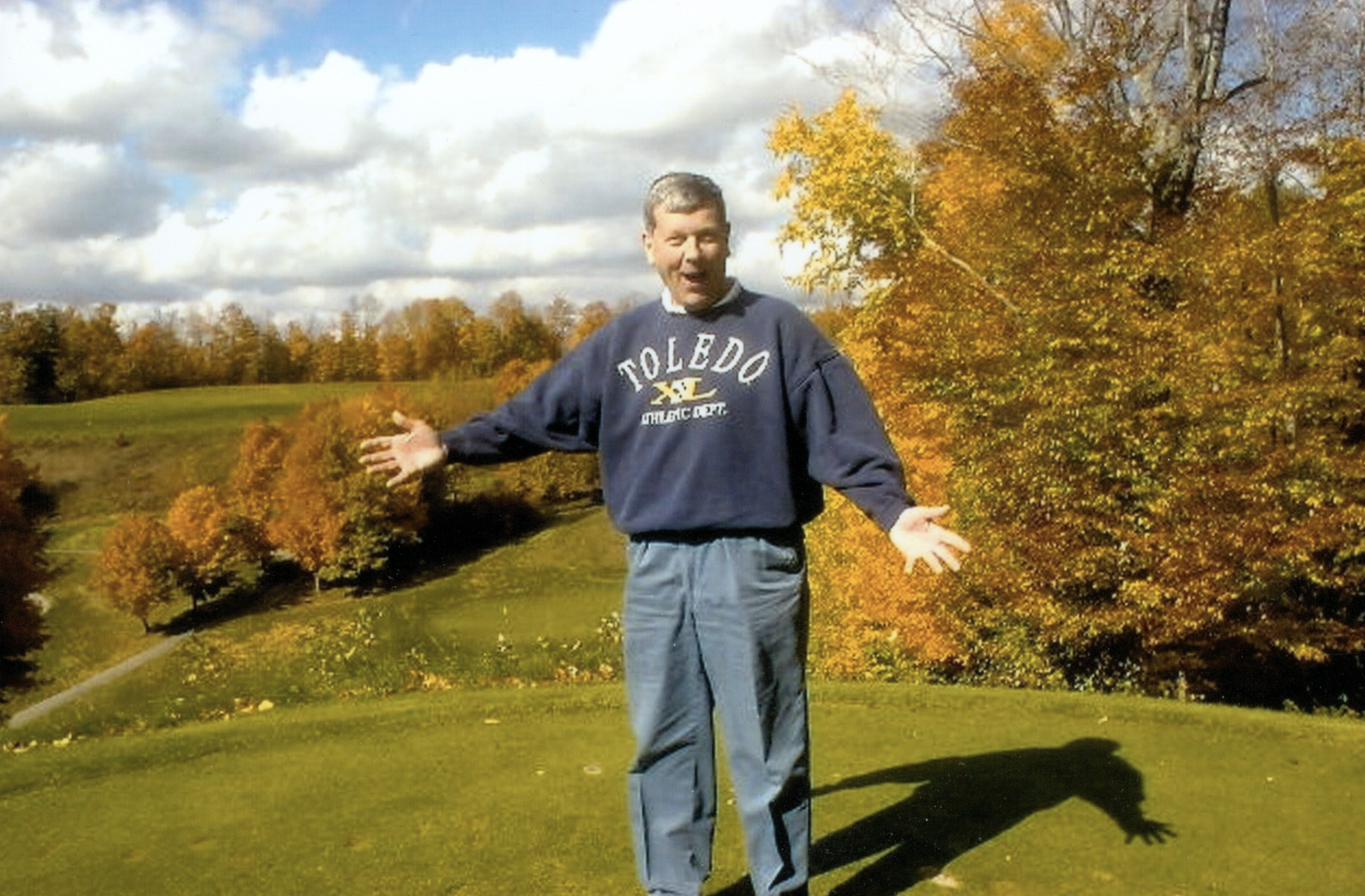
Wayne, the husband, father, firefighter, friend and dignified man…did not have the option to take The Tomorrow Test.
Jude Crittenden is a member of the Toledo community.
Measles Must Go
by Emery Sandler
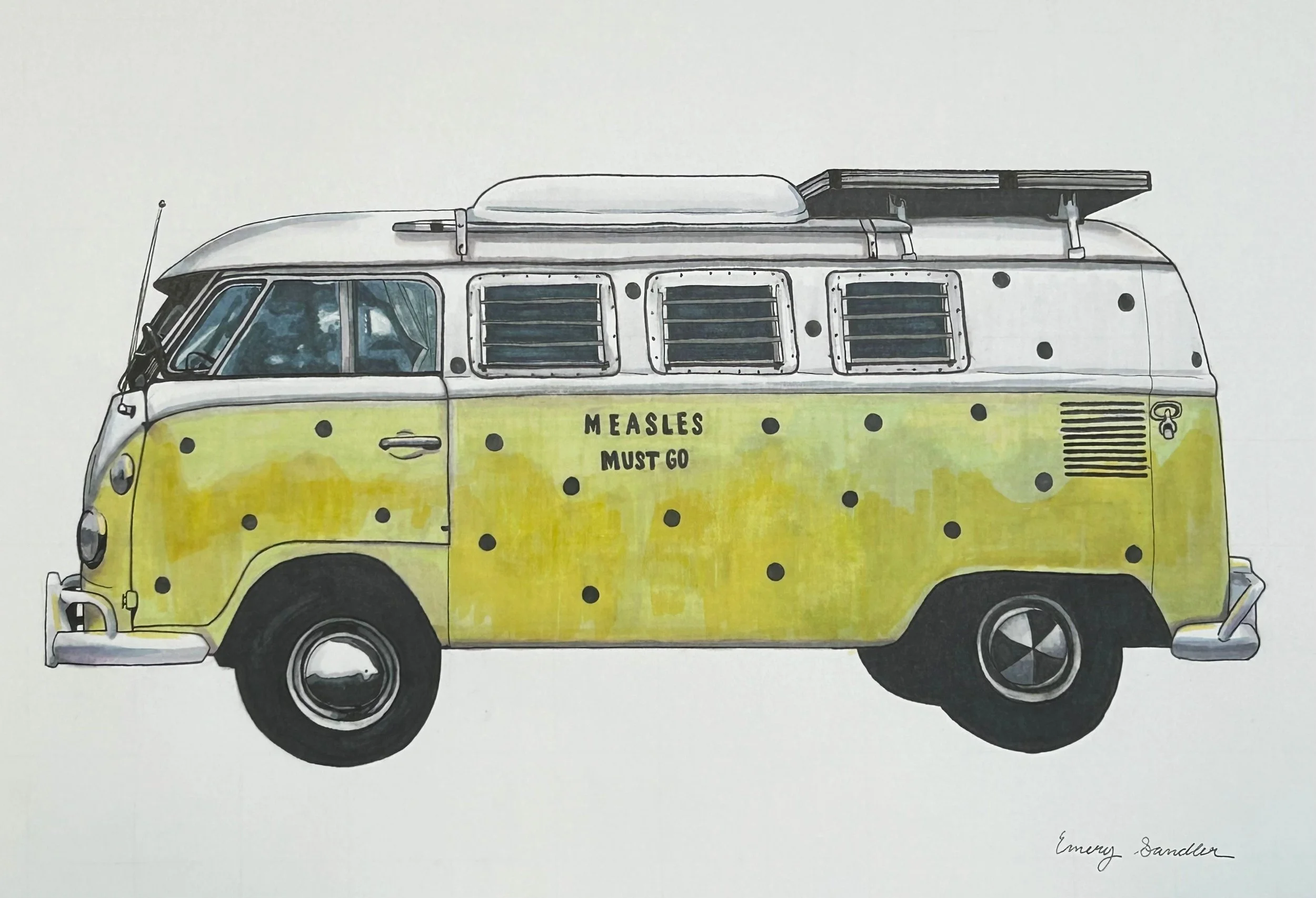
Artist’s Statement:
This piece is based on a historical image from the CDC archives of a late 1960s-1970s measles vaccine delivery vehicle. I chose to draw it in color to represent the threat of measles returning to the modern day. My work was inspired by the need to remember all the work that has been put into public health, and to appreciate what it has done for us.
Media: 11x14in ink and alcohol marker on Bristol paper.
Emery Sandler is a second-year medical student at UTCOMLS.